
You spent decades being responsible. You did the right things. Stable job. Good salary. Reliable benefits. And yet something kept quietly nagging at you — this low-level voice asking: Is this really all there is?
That was me at 49. Solid career in sales and marketing. A respectable title. And a growing sense that I was spending my best energy building someone else’s future, not my own.
Leaving my corporate job at 50 is one of the hardest and best decisions I’ve ever made. Not because it was smooth or safe. But because it was finally honest.
This is the real story — the fears, the pushback, the practical math, and what I actually found on the other side.

The Breaking Point That Started It All
25 Years on a Path I Didn’t Choose
My career looked good on paper. Sales and marketing at large companies for over two decades. I’d hit targets, managed teams, navigated office politics, and earned promotions.
But somewhere around year 22, I noticed something uncomfortable: I had built a solid career inside someone else’s company. Not my own life.
The work wasn’t meaningful anymore. Every year blurred into the next — same meetings, same quarterly reviews, same performance cycle repeating itself. I wasn’t burned out in a dramatic way. I was something quieter and harder to name: slowly checked out. I still showed up. I still delivered. But I’d stopped caring about the outcome.
The Sunday Night Feeling That Changed Everything
You probably know the Sunday night feeling. That low-grade anxiety that kicks in around 6 PM every week. The quiet dread of Monday.
For me, it got worse every year after 45. At some point I asked myself honestly: what exactly am I dreading? The answer was clear and a little uncomfortable: another week doing work I didn’t believe in, for a future I hadn’t designed.
That was the crack. Not a dramatic breakdown. Not a single explosive moment. Just a slow, honest realization that I had been running the wrong race — and I was the only one who could stop.
The Decision — and the Pushback
What People Said When I Told Them
When I started telling people I was thinking about leaving my corporate job at 50, the reactions were almost identical across the board.
“Aren’t you too old to start over?”
“What about your pension?”
“You have such a stable position — why would you walk away from that?”
My closest colleagues thought I was having a midlife crisis. A few genuinely worried about me. One manager pulled me aside and said, “Nobody leaves at your stage unless they’re forced out.”
That comment helped me more than he intended. It confirmed what I’d been sensing: most people around me were running the same mental program — stay safe, minimize risk, do what’s expected. I’d been running that program for 25 years. I was ready to write a new one.
The Numbers I Ran Before Walking Out
I didn’t quit on emotion alone. I spent three months doing the math.
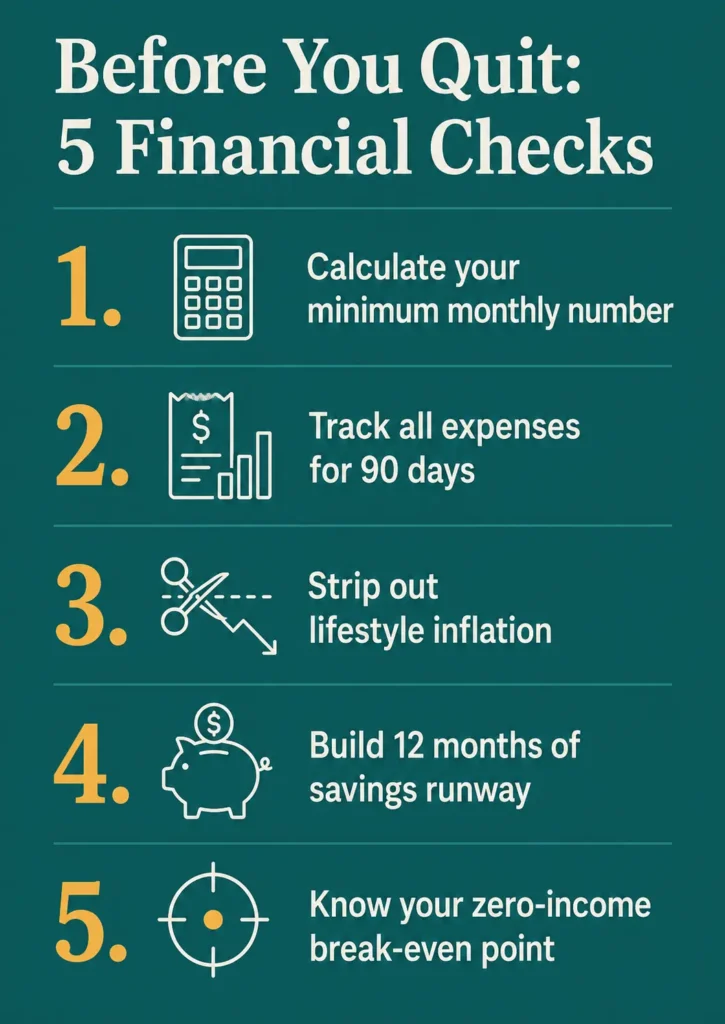
I calculated the minimum monthly income I needed to cover essentials — rent, food, health insurance, utilities. I tracked every expense for 90 days straight. I worked out exactly how long my savings could support me if I earned nothing for a full year.
What surprised me: my number was lower than I expected. Most of my spending had been lifestyle inflation — things I bought because I had a corporate salary, not because they made me genuinely happy. Business lunches. A gym membership I used twice a month. A car that said more about my job title than my actual needs.
Once I stripped those away, the math looked completely different. Running the numbers didn’t eliminate the risk. But it made the risk feel manageable — and that changed everything.
My First 90 Days Without a Paycheck
The Freedom That Felt Like Falling
The first week after I left, I felt genuinely free. No commute. No performance reviews. No email chains copied to fifteen people about Q3 forecasts.
By week three, the silence started to feel unusual.
Here’s what nobody warns you about leaving corporate life at this stage: the identity shock. For more than two decades, my job had told me who I was. The title. The company name. The business card. When that was gone, I had to answer a harder question — who am I when no one is watching?
It’s not a comfortable question. Especially if you’ve spent twenty years not asking it. I had to sit with that discomfort, not fix it quickly or distract myself from it. That sitting-with-it phase was slower and more important than I expected.
Building a New Routine From Nothing
The biggest mistake I made in month one was treating every day like a weekend.
Sleep in. Do some loose thinking. Watch a few videos about remote work. Tell myself I was being strategic.
By month two, I was behind on everything and quietly anxious about my savings runway shrinking.
The shift that saved me: building structure from scratch. I set a firm start time — 7 AM. I blocked work hours the same way I used to block meetings. Weekly goals replaced daily to-do lists. No news until after noon.
Structure isn’t a corporate invention. It’s a human need. In an office, someone provides it for you. On your own, you have to build it yourself. That took me two full months to internalize — and once I did, my productivity came back fast.

How I Built My Remote Work Life
The Tools That Replaced My Corporate Safety Net
At a large company, you have an invisible support system running in the background. IT. Accounting. Legal review. HR. Admin staff. Meeting schedulers. You use all of it without thinking.
When you go independent, you replace every piece of that — with AI tools, solid systems, and personal discipline.
I started using AI writing assistants for drafting communication, planning content, and thinking through decisions. Notion became my organizational backbone. Canva replaced what used to require a design request with a two-week wait. Scheduling and automation tools handled coordination that used to involve five people.
Was it more work upfront? Yes. But the tradeoff was zero bureaucracy, zero waiting for approval, and complete ownership of my direction. Every tool I learned became a permanent asset — not a workaround, but a real capability I carry forward.
Shifting from Employee Mindset to Owner Mindset
The biggest internal shift wasn’t a skill. It was a mindset.
As an employee, you wait for direction. You’re rewarded for execution, not initiative. Success means completing what you were asked to do, on time, without creating problems.
As an independent worker, nobody tells you what to do. Accountability is entirely yours. Every decision — what to build, what to cut, what to prioritize — lands on you alone.
This took me four months to genuinely internalize. I kept second-guessing whether I was “doing enough.” Without a manager or performance review cycle, the goalposts felt invisible.
The shift happened when I stopped measuring my days by hours worked and started measuring by what I actually created or moved forward. The question changed: from “What should I be doing?” to “What do I want to build?” That single reframe changed how I approached everything.
What I Wish I Had Done Sooner
Skills I Should Have Stacked Earlier
Looking back, the one thing I’d change: start building digital skills while I still had a salary coming in.
Content writing. Basic SEO. How to grow an online audience. How to monetize a blog or newsletter. None of these are overly complex. But they do take time to develop — and that time is far less stressful when income is still arriving every month.
If you’re currently in a corporate job and quietly thinking about your exit, here’s the most useful advice I have: start building something now. A blog. A newsletter. A small consulting side practice. A portfolio of work you can actually point to.
Don’t wait until after you quit to figure out what you’ll do. Lay the groundwork before you need it. Even small momentum built while you’re still employed becomes a significant advantage the day you leave.
The Financial Buffer That Saved Me
The most important practical step I took: building 12 months of living expenses before I quit.
Not saying this to intimidate you. Saying it because that buffer completely changed my decision-making quality.
When you’re not panicking about money, you make smarter choices. You don’t take the wrong client because you’re desperate. You don’t rush to publish bad work just to generate a few dollars. You have time to build things properly and let them grow.
Desperation kills good strategy. Runway removes desperation.
If you’re planning an exit from corporate life, prioritize this above almost everything else — even if it means staying six extra months, even if it means cutting expenses sharply right now.
Your financial runway is your emotional runway. Protect it.
One Year Later: What the Scoreboard Says
I won’t pretend the first year was a home run. My income was significantly lower than my corporate salary. There were months I questioned whether I’d made a massive mistake. There were weeks when the uncertainty felt heavier than expected.
But here’s the honest accounting of what I gained.
I decide where I work. I decide when to start and when to stop. I decide what projects deserve my energy and which ones don’t. I haven’t had a Sunday night dread in over a year. When I travel, I bring my work with me — and that’s a feature, not a problem. My mornings belong to me, not to a commute or a status meeting.
Was it worth leaving my corporate job at 50? Yes. Completely.
Not because it was safe. Not because it was easy. Because it was real.
If you’re standing at the same crossroads — older than you expected when making this kind of move, unsure whether it’s too late — let me be direct: it’s not too late. It never is. But it does require honest preparation and a willingness to be uncomfortable for longer than feels comfortable.
The best time to have started this would have been ten years ago. The second-best time is now.
What’s Next?
Leaving corporate life is only the beginning. Once you’re free from the 9-to-5, a new challenge surfaces fast — figuring out how to actually live well as a remote worker without losing your structure, your sanity, or your sense of balance in the process.
Because freedom without structure isn’t freedom. It’s just a different kind of chaos.
👉 Read next: Work-Life Balance as a Digital Nomad: What No One Tells You