You keep hearing that you need to “learn AI” before you get left behind. So you open a search bar, type it in, and get buried. Coursera specializations. YouTube playlists. Bootcamps that cost more than your monthly rent. Free courses that promise to make you an “AI expert” in one weekend.
I went through this same rabbit hole a few months ago. After 25 years in corporate sales and marketing, I quit my last job and started building an online business from scratch. Learning AI wasn’t optional — it was survival. So I tested a stack of AI skills courses, free and paid, and this post is the shortcut I wish someone had handed me.
Why Everyone Suddenly Needs AI Skills Courses
Here’s the honest truth: you don’t need a computer science degree to use AI well. Most people who are winning right now aren’t machine learning engineers. They’re marketers, writers, solopreneurs, and small business owners who learned just enough to use the tools intelligently.
That’s the gap the best AI skills courses are built for. They’re not trying to turn you into a researcher at a lab. They’re teaching you how to prompt well, automate a workflow, or understand what a large language model can and can’t do, so you stop guessing and start building.
The catch is that the AI education space is crowded and uneven right now. Some courses are excellent and genuinely free. Others charge a lot for content you could get for nothing elsewhere. Knowing which is which saves you weeks.

Best Free AI Skills Courses in 2026
Free doesn’t mean low quality anymore. Some of the strongest AI education available right now costs nothing.
DeepLearning.AI’s Short Courses
DeepLearning.AI, founded by Andrew Ng, offers a set of short courses built directly with companies like OpenAI, Anthropic, and Google. Each one runs one to two hours and focuses on a single practical skill: prompt engineering, retrieval-augmented generation, working with AI agents, and more. They’re free, they include hands-on notebooks, and because the people who build the actual AI tools helped design the lessons, the content stays current.
Start with the prompt engineering course before anything else. It’s short, practical, and it changes how you talk to every AI tool you touch afterward.
Google AI Essentials
Google offers a beginner-friendly course through Coursera that focuses on using AI tools in everyday work rather than the theory behind them. It covers prompt writing, workplace use cases, and responsible AI use. If you’re not technical and just want to stop feeling behind at your job, this is a solid entry point.
Fast.ai’s Practical Deep Learning
If you want to go a level deeper and actually understand how models are built, fast.ai takes a build-first approach. You train a working image classifier in the very first lesson, then work backward into the theory. It’s free, and it’s taught by people with real production experience, not just academic backgrounds.
Coursera’s Free Audit Tracks
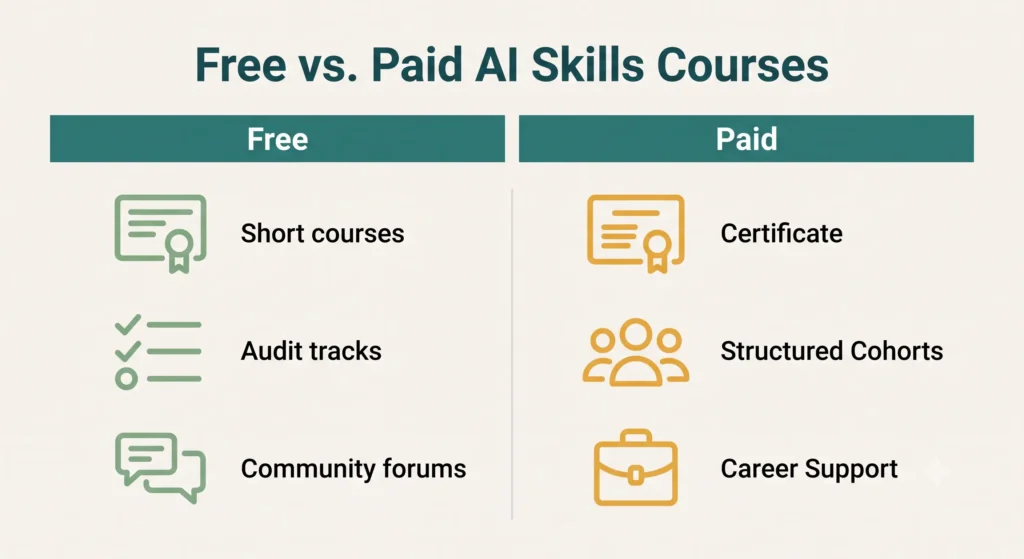
Many Coursera courses, including Andrew Ng’s well-known Machine Learning Specialization, can be audited for free. You get the full lectures and materials; you just won’t get a certificate unless you pay. If your goal is knowledge rather than a credential to show an employer, auditing is the cheapest way to access university-level AI education.
Best Paid AI Skills Courses in 2026
Paid courses earn their price when they add structure, credentialing, or access you genuinely can’t get for free.
IBM Applied AI Professional Certificate
This Coursera-hosted certificate runs around $49 a month and focuses on applied, project-based learning rather than theory. It’s a reasonable pick if you want a recognized name on your resume without spending thousands. The projects give you something concrete to point to, which matters more than the certificate itself.
DeepLearning.AI Specializations
Beyond the free short courses, DeepLearning.AI offers longer paid specializations covering deep learning, natural language processing, and generative AI in more technical depth. These make sense once you’ve outgrown the free short courses and want to specialize, particularly if you’re aiming at a technical AI role.
Google and AWS Cloud AI Certifications
If you’re moving toward a technical role, certifications like Google’s Professional Machine Learning Engineer or AWS’s AI-focused credentials carry real weight with employers. They require renewal every so often, since the field moves fast, but that’s arguably a feature — it keeps the credential meaningful instead of stale.
University Executive Programs
For senior leaders where a name-brand credential genuinely matters in your specific industry or negotiation, executive AI programs from business schools like Kellogg are worth considering. These cost more, sometimes thousands of dollars, and make the most sense when the institution’s name opens doors that a Coursera certificate won’t.
How to Choose Between Free and Paid
Match the Course to Your Actual Goal
Before you enroll in anything, get specific about what you’re actually trying to do. “Learn AI” is too vague to act on. “Learn to automate my content workflow” or “understand enough to manage an AI project at work” is something a course can actually be matched to.
If your goal is business literacy, free courses like Google AI Essentials cover you completely. If your goal is a technical career switch, you’ll eventually need paid specializations or certifications to go deep enough. Most people overestimate how much they need the paid tier before they’ve even finished the free content.
Stop Collecting Certificates, Start Building
This is the part almost nobody tells you. Watching seven courses back-to-back without building anything is the fastest way to forget everything you just learned. The people who actually retain AI skills courses content are the ones who stop after each course and build something small with it — an automation, a prompt template, a mini project.
Certificates look nice on LinkedIn. Projects are what actually get you hired or get your business unstuck.

My Recommended Starting Path
If you want a simple sequence instead of a wall of options: start with DeepLearning.AI’s prompt engineering short course this week. It takes under two hours and immediately changes how you use every AI tool you already have. Follow it with Google AI Essentials if you want business context, or fast.ai if you want to go technical.
Only move to a paid certificate once you know exactly which gap it fills for you. Most people don’t need to spend a cent before they’ve built their first real project.
The best AI skills courses in 2026 aren’t the ones with the flashiest marketing. They’re the ones that get you building something within the first week.
What’s Next?
Learning AI skills is one thing — but growth doesn’t stop at courses. If you’ve been feeding your brain with structured lessons, it’s worth balancing that with something slower and more reflective: the books that actually shape how you think about work and money. Some of the biggest shifts in how I run my own business came from a handful of books, not courses.
👉 Read next: 5 Books That Changed How I Think About Work and Money