Every adult wants to learn a new skill faster — video editing, a new language, coding, whatever it is — without sitting through a 40-hour course built for someone else’s pace. I spent 25 years in corporate sales and marketing. When I left my last job in April 2025 to build an online business from scratch, I had to pick up video editing, WordPress, SEO, and half a dozen AI tools in a matter of months, with no classroom, no mentor, and honestly, no clue where to start. What actually worked wasn’t more courses — it was treating AI like a personal tutor instead of a search engine. Here’s exactly how that method works, step by step.

Why Learning New Skills as an Adult Feels So Hard
The Problem With Generic Online Courses
Most online courses are built for the average student, not for you specifically. They open with “what is a computer” or jump straight into advanced material with no bridge in between. You end up watching hours of content that doesn’t apply to your actual goal, and the course never adjusts when you get stuck. That mismatch — not a lack of discipline — is the real reason so many adults quit a course halfway through. The curriculum was never built for their starting point, their schedule, or the specific problem they’re actually trying to solve.
There’s also a hidden cost nobody talks about: sunk-cost guilt. Once you’ve paid for a twelve-module course, you feel obligated to sit through every module in order, even the ones that don’t apply to you. That obligation slows you down more than the material itself ever could.
Why You Forget What You “Learned” Last Week
Watching a tutorial feels like learning, but it isn’t. Passive video-watching creates a false sense of progress. Without active recall — being forced to explain or apply something yourself — most of what you watch evaporates within a few days. Adults especially need a little friction: a chance to be wrong, corrected, and asked to try again. A static video can’t give you that. An AI tutor can, on demand, at any hour, as many times as it takes.
What Makes AI a Better Tutor Than a Course
The fastest way to learn a new skill faster isn’t more content. It’s faster, more specific feedback loops — and that’s exactly what a course can’t offer but an AI tutor can.
It Adjusts to Your Pace and Your Mistakes
A course has one script for everyone. An AI tutor has none — it responds to what you actually typed. If one explanation confuses you, you can ask it to try again using a completely different analogy, ideally one from your own field or background. Ask a video course to explain something differently and you’ll get silence. Ask an AI tutor, and it will rephrase the same idea five different ways until one of them clicks. That back-and-forth is the single biggest advantage AI has over pre-recorded content, and it’s what actually helps you learn a new skill faster than a static course ever could.
It’s Available Whenever You Actually Have Time
You don’t learn on a fixed class schedule. You learn in 20-minute pockets between client calls, on a train, or at 11 PM once the house is quiet. AI tutors don’t care when you show up or how many times you ask the same question a different way. That availability alone removes one of the biggest reasons adult learners fall behind on anything they start — the gap between “I have ten free minutes” and “the next lesson isn’t until Thursday.”
The AI-as-Tutor Method, Step by Step
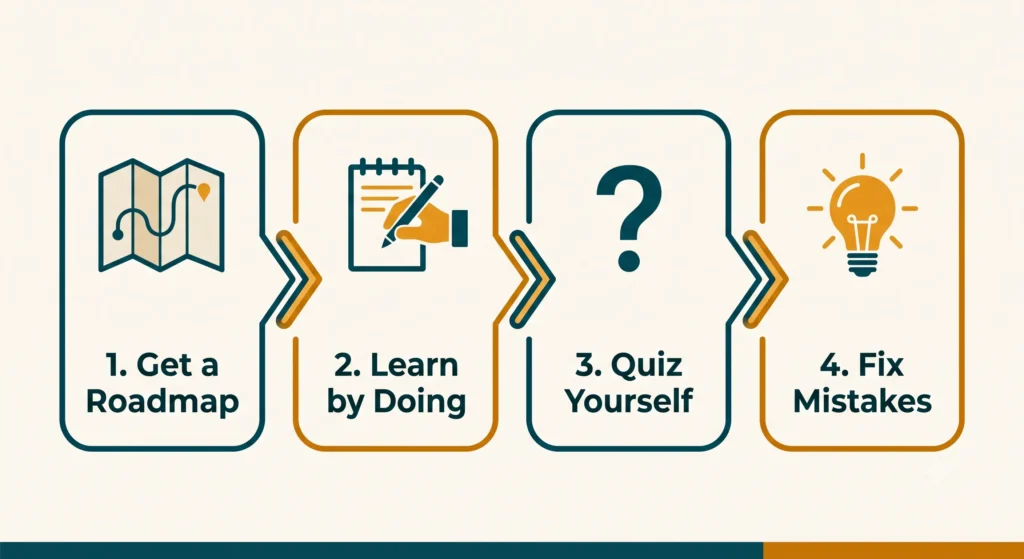
Here’s the exact method I used to learn a new skill faster than any course I tried, broken into four repeatable steps you can apply to almost anything — a language, a design tool, a spreadsheet skill, or a whole new career direction.
Step 1 — Get a Beginner Roadmap, Not a Full Curriculum
Don’t ask AI to “teach me Python” or “teach me video editing.” Ask it to build a focused two-week roadmap based on your specific goal — for example, “I want to write a script that renames files automatically, and I’ve never coded before. Give me a two-week roadmap with one small task per day.” A narrow roadmap keeps you moving toward something you’ll actually use, instead of drowning in a generic syllabus you’ll never finish. You can also ask it to estimate how much daily time each step realistically takes, so the plan fits your actual schedule instead of an imaginary one.
Step 2 — Learn by Doing, Then Ask Why
Skip the theory-first approach most courses default to. Try the task first — write the paragraph, attempt the formula, record the clip — even if you get it wrong. Then bring your attempt to the AI and ask what went wrong and why. Learning the “why” after a real attempt sticks far better than learning it before you’ve tried anything at all, because your brain now has a specific mistake to attach the explanation to instead of an abstract rule.
Step 3 — Turn AI Into Your Personal Quiz Master
Instead of asking for more material, ask it to quiz you. A simple prompt like “give me five questions to test whether I actually understood this, and tell me where I’m wrong” turns a passive reading session into active recall, which decades of cognitive science research point to as one of the most effective learning techniques there is. Do this at the end of every session, even a short one.
Step 4 — Ask It to Explain Your Mistakes in Plain Language
When you get something wrong, most courses just show you the correct answer and move on. An AI tutor can explain why your specific answer was wrong, in the context of what you were actually trying to do. That specificity is what turns confusion into a genuine “aha” moment instead of another gap you paper over and forget by next week.
Which AI Tools Work Best for Self-Directed Learning
ChatGPT and Claude for Step-by-Step Explanations
Both are strong at breaking a concept into smaller steps and adjusting the explanation when you say “I still don’t get it.” Claude in particular tends to give longer, more structured breakdowns, which helps with anything that has a clear sequence — coding, long-form writing, or spreadsheet formulas you need to build one piece at a time. Both tools can also hold context across a long back-and-forth session, so you don’t have to re-explain your goal every single time you ask a follow-up question.
Gemini for Visual and Real-World Practice
Gemini’s strength is connecting a concept to something visual or current in real time, which is useful for skills like design, photography, or anything where you need a reference image or an up-to-date example while you practice. It’s a strong second tool to pair with ChatGPT or Claude rather than a replacement for either.

Three Mistakes That Slow Down AI-Assisted Learning
The most common one is treating AI like a search engine — typing a question, copying the answer, and moving on without practicing it yourself. Reading an explanation is not the same as being able to reproduce it under pressure, and skipping practice is the fastest way to feel like you “know” something you actually can’t do yet.
The second mistake is asking for the full explanation up front instead of attempting the task first, which skips the productive struggle that actually builds skill. It feels more efficient in the moment, but it produces knowledge that doesn’t stick.
The third is not saving what you learn. Keep a simple running note — a plain text file works fine — of the corrections and explanations that clicked for you, because you will absolutely need them again in a week, and re-explaining the same thing from scratch wastes the time you were trying to save in the first place.
None of these mistakes are permanent. Each one is a habit, and habits are easy to swap once you notice them. The fix for all three is the same: slow down by a few minutes per session, practice before you peek at the answer, and write down what actually worked so future-you doesn’t have to relearn it from zero.
What I Learned Teaching Myself With AI After 50
Nobody tells you that learning gets harder to start, not harder to finish, once you’re past 40 or 50. The hesitation before you open the tutorial is worse than the tutorial itself. What changed things for me wasn’t more discipline — it was lowering the cost of asking a “dumb” question. An AI tutor never sighs, never makes you feel behind, and never runs out of patience at 1 AM when you’re three tabs deep into a WordPress plugin that refuses to cooperate.
Twenty-five years in a corporate job trains you to look competent in front of people. Learning something new, badly, in front of a real teacher can feel like exposing that you don’t have it all figured out anymore. An AI tutor removes that entire layer of self-consciousness. You can ask the same basic question four different ways until it finally lands, and nobody remembers you asked. If you’re rebuilding a skill set later in life, on your own timeline, that quiet patience is worth more than any paid course.
What’s Next?
Once you’ve got a system for picking up new skills quickly, the next question is how to protect the parts of you that AI can’t replace. That’s exactly what we’re covering next — how to stay grounded, curious, and unmistakably you in a world where AI is doing more and more of the thinking for people who let it.