
Everyone told me working from Bali would change my life. They weren’t wrong. But they left out the part about answering emails at midnight because my client was in New York. They didn’t mention missing three sunsets in a row because “I just need to finish this one thing.” Or the low-grade guilt that hums in the back of your mind every time you’re not working — because technically, you could always be working.
That’s the part no one puts in the caption.
Nomad work-life balance is one of the most talked-about topics in the remote work space — and one of the least honestly examined. The lifestyle looks perfect from the outside: beautiful locations, flexible hours, no manager watching the clock. But the inside story is messier than the highlight reel suggests.
This guide doesn’t offer a three-step formula that solves everything. What it does offer is an honest look at the specific ways balance breaks down for people living and working on the road — and the practical strategies that actually help, from someone who’s been through the messy middle.

The Dream vs. The Reality
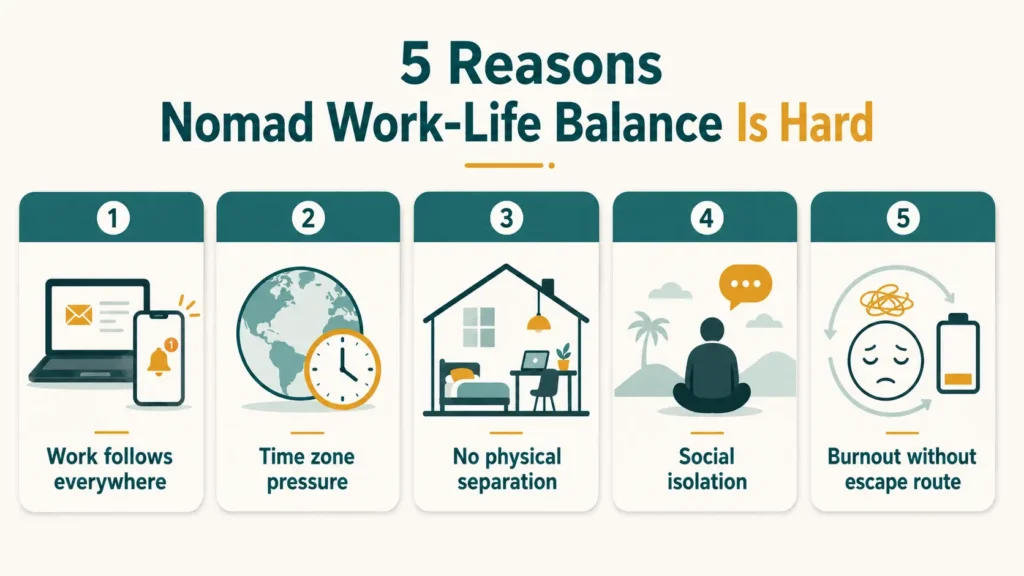
When Work Follows You Everywhere
Office workers have a commute. That commute is annoying — but it also acts as a mental buffer between work and the rest of life. You leave the office. You drive or ride home. Work stays behind.
Digital nomads don’t have that buffer.
Your laptop travels with you everywhere. Your phone has Slack, Gmail, Notion, and five other apps refreshing quietly in the background. Whether you’re sitting in a café in Chiang Mai or at a beachside table in Lisbon, the tools are right there. And that means the urge to “just check” follows you into every moment of every day.
Most people discover this within their first month on the road. Work doesn’t just follow you — it expands to fill whatever space you give it. Without a clear structure that forces it to stop, it never really does.
The Blurry Line Between Work and Life
Here’s what makes nomad work-life balance especially difficult: you’re usually working from places that other people visit on vacation.
Your “office” might overlook rice fields or a harbor. Your lunch break might involve a short walk to a market tourists pay to visit. This sounds extraordinary — and sometimes it genuinely is. But it creates a persistent, draining psychological tension.
You feel like you should be soaking in every moment because the location is remarkable. When you’re buried in a spreadsheet instead, you feel like you’re wasting it. When you finally step away, the voice in the back of your head says you’re falling behind.
That loop is hard to explain to people who haven’t experienced it. The beauty of your surroundings doesn’t automatically create inner peace. It takes intentional structure to make this lifestyle actually work.
Why Balance Breaks Down on the Road
Time Zones Are a Double-Edged Sword
For freelancers and remote workers with clients or teams in other regions, time zones quietly multiply your workload.
If you’re based in Southeast Asia but your clients are in the United States, you’re looking at a twelve-to-fourteen-hour gap. Their morning messages hit your evening. Their urgent end-of-day requests arrive just as you’re trying to unwind. Without a deliberate policy in place, you end up bookending your entire day with work — and never actually switching off.
This is manageable, but only through intentional planning. Some nomads flip their schedule entirely, sleeping through the morning and working evenings to match client hours. Others set firm communication windows and train clients to expect responses within a defined window rather than immediately. Both work. What doesn’t work is letting the time zone make the decision by default.
Your Office Is Also Your Bedroom
Most people underestimate how much the physical separation of spaces shapes mental state.
When you work from a hostel room or short-term rental, your brain has to perform “work mode” and “rest mode” in the exact same four walls. That’s cognitively expensive. Over time, the bed starts triggering task lists. The couch becomes associated with unfinished projects. The space never fully registers as rest — because it isn’t.
This isn’t a discipline problem. It’s a design problem. The most effective fix isn’t more willpower; it’s geography. Leave the room for work whenever possible. A nearby café or a co-working day pass creates the physical separation your brain actually needs. Protect the space where you sleep from work associations as much as you can.
The Real Challenges Nobody Warns You About
Social Isolation and Reverse FOMO
The nomad lifestyle involves constant movement. Movement means making new connections repeatedly — and rarely sustaining deep ones.
You meet great people. You’re in the same city for three weeks. Then one of you moves on. You stay loosely in touch online, make vague plans to cross paths again, and mostly never do.
This creates a specific kind of loneliness that’s hard to name. You’re rarely physically alone — you’re surrounded by other travelers, fellow nomads, and locals wherever you go. But meaningful relationships take time and proximity, and the nomad life often doesn’t offer either.
There’s also a reverse version of FOMO: watching friends back home hit milestones — promotions, weddings, mortgages — from a café table abroad, and quietly wondering if you’re drifting off the map of “normal life.” Neither feeling means the lifestyle is wrong. But pretending they don’t exist doesn’t make them disappear.
The Guilt of Stopping Work
When you’re self-employed or working remotely with no fixed hours, stopping every single day requires a deliberate act of will. Nobody turns off the office lights at 5 pm. Nobody tells you when to log off.
This breeds what I’d call productivity guilt — the persistent feeling that you should be doing more, that rest is just avoidance dressed up, that a good day is measured by hours of output.
It’s a trap. It’s especially common in the early phase of the nomad life, when you’re still silently proving to yourself — and to everyone who doubted you — that this whole thing is real and sustainable.
Rest is not the enemy of productivity. It’s the raw material of it. But turning that knowledge into a daily habit takes more than just understanding it.
Burnout in Paradise
Here’s the version of the nomad story that almost never gets shared: burnout on the road hits differently, because there’s nowhere obvious to escape to.
When you burn out at a traditional job, the answer is usually a vacation — go somewhere new, decompress, come back reset. But when your life is already a kind of extended travel, what does escape even look like?
Nomad burnout often shows up as numbness rather than exhaustion. The new cities stop feeling new. Sunsets become background noise. Work turns mechanical and joyless. You don’t understand why, because from the outside, everything looks exactly like the life you worked for.
That’s your system signaling that it needs genuine rest — not another flight, not another scenic destination, but real stillness. Staying in one place for a month, slowing the pace down intentionally, often does more than any change of scenery.
What Actually Works: Practical Strategies
Create Hard Stops, Not Flexible Guidelines
“I’ll try to finish up around 6 pm” doesn’t work. “I close the laptop at 6 pm, no exceptions” does.
Hard stops are firm, non-negotiable endpoints to the workday. Set one at a consistent time. Block it in your calendar. Use a timer if that helps. When it goes off, close the laptop — even if the task isn’t done.
This feels uncomfortable at first. Most driven remote workers are conditioned to push until the work is finished. But the work is never finished. There is always more. The goal of a hard stop isn’t to clear the to-do list — it’s to protect the recovery time that keeps you sustainable over months and years, not just days.
Build a Location-Independent Routine
When everything around you shifts constantly — city, language, weather, culture — your internal routine becomes the single stable thread running through your days.
Choose two or three small habits that travel with you regardless of where you are: a morning walk before opening the laptop, a specific type of café for deep work sessions, a brief wind-down ritual that signals the workday is over. These habits don’t need to be elaborate. They just need to be consistent.
Consistency creates psychological continuity. Your brain learns to read the time of day from behavioral cues rather than from location. That internal continuity is a core part of what makes nomad work-life balance sustainable past the first exciting month on the road.
Choose Your Work Environment Intentionally
Where you work affects far more than just your output — it shapes how you feel at the end of the day.
A noisy hostel common area is free. It’s also draining. A proper co-working space with ergonomic seating, fast internet, and a room full of other focused professionals is worth the cost — not only for productivity, but for the social environment it provides.
Good co-working spaces restore something the nomad road quietly erodes: routine, community, and a clear physical line between work and not-work. When you pack up and walk out at the end of the day, something in your brain registers the transition. That simple boundary does more for mental health than most systems or frameworks.
The right workspace isn’t a luxury. It’s infrastructure.

What’s Next?
Understanding the challenges of nomad work-life balance is step one. Step two is finding the physical environments that actually support it. The right co-working space can shift everything — your daily focus, your energy levels, and the quality of connections you build while on the road.
👉 Read next: Best Co-Working Spaces in Asia for Remote Workers