The version of passive income the internet sells you is almost always a fantasy. The lazy-beach-laptop mythology. The “wake up to money in your account” highlight reel.
The version that’s actually achievable looks different: content that keeps earning after you stop actively working on it, products that sell without you in the room, systems that generate value while you’re doing something else entirely.
Passive income streams have always required a genuine upfront investment — time, skill, or both. What AI changes in 2026 is the cost of that investment. Skills that used to take years to develop adequately now take weeks. Content that used to take a full day to produce now takes a few hours.
This post covers five streams that are genuinely buildable with AI assistance. Not overnight. Not guaranteed. But realistic for someone willing to put in consistent work upfront and patient enough to let the compounding happen.
Why AI Changes the Passive Income Equation
Most people have ideas that could generate passive income. What stops them isn’t imagination — it’s the gap between the idea and the skills required to execute it. A good niche concept, but can’t write consistently. A design idea, but no design background. Deep knowledge in a field, but no idea how to package and sell it.
What AI Actually Removes From the Equation
AI tools don’t create passive income for you. What they do is close the skill gaps that typically stop people from starting.
You don’t need a graphic design background to create products with polished visuals — AI image generators handle that. You don’t need to be a professional writer to produce well-structured, readable content — AI dramatically lowers the barrier to a strong first draft. You don’t need a video production setup to put together a presentable YouTube video — AI script, voiceover, and editing tools change the math entirely.
The inputs AI can’t replace: your niche judgment, your editorial standards, your consistency, and your patience. Those remain human jobs.
The One Thing AI Still Can’t Build For You
An audience.
Every passive income stream eventually depends on people finding your content, your products, or your channel. AI accelerates production. It does not accelerate trust-building or discoverability. That part still takes months, not days.
Set the expectation correctly from the beginning: the upfront work is real, the passive element comes later. Anyone selling you a faster timeline is selling you something else.
Stream 1: AI-Assisted Blogging
A blog that earns through display advertising and affiliate placements is one of the most established passive income models online. The mechanic is straightforward: write posts that rank in search results, attract consistent traffic, and earn revenue per visit or per click.
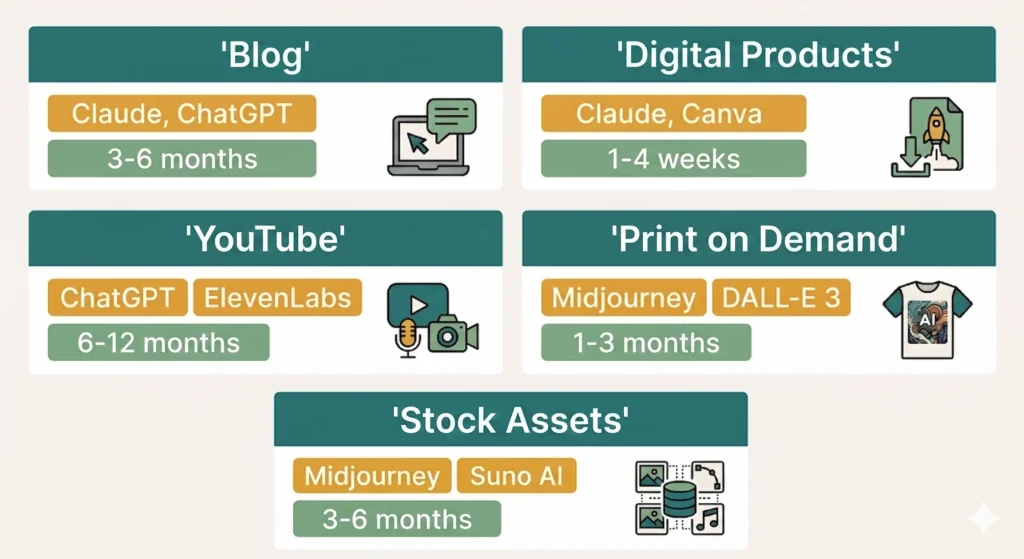
AI doesn’t change the model — it changes the production speed. Using Claude or ChatGPT to research, outline, and draft posts compresses a full writing day into two or three hours. AI tools help identify keyword angles, content gaps, and structural weaknesses before you even start writing.
The passive element activates once posts rank in search results. A well-optimized post can generate traffic — and income — for years without any further input.
What the Setup Actually Looks Like
You need a self-hosted WordPress site, a consistent publishing schedule (at minimum two posts per week in the early months), a working understanding of SEO keyword research, and a monetization layer — Google AdSense for display ads, plus affiliate partnerships once traffic builds.
Realistic time to first meaningful income: three to six months. The bottleneck is earning search engine trust, which requires both content volume and time in the index. This is the slowest-starting stream on this list and the one that compounds most durably over time.
Stream 2: Digital Products Built With AI
Digital products — e-books, template packs, Notion dashboards, prompt libraries, checklists, mini-guides — are the highest-leverage passive income stream for solo creators. Build once, sell indefinitely, zero inventory required.
AI dramatically shortens the creation timeline. An e-book that previously required weeks of research and writing can be outlined, drafted, and revised in days using AI tools as research and writing partners. Design platforms with built-in AI features handle layout and basic visual formatting without requiring design expertise.
The Products That Sell Best
Products that convert reliably share one characteristic: they save the buyer measurable time or solve a specific, clearly defined problem.
A “50 ChatGPT Prompts for Freelance Writers” pack solves a specific problem for a specific person. A Notion freelance business template saves concrete setup time. A beginner’s guide to a defined skill set teaches something with a clear outcome. Broad, general products rarely sell as consistently as narrow, specific ones — even when the narrow product is smaller and took less time to produce.
Platforms like Gumroad, Payhip, and Stan Store let you sell digital products with minimal technical setup. Combined with AI-accelerated creation, the time from idea to live product is now measured in days rather than months.
Stream 3: Faceless YouTube Channels
A faceless YouTube channel is one where no human appears on camera. The content typically uses screen recordings, slideshow-style visuals, stock footage, or illustrated explainers — driven entirely by narration rather than on-screen personality.
AI has made this format significantly more accessible. Scripts drafted by ChatGPT or Claude. Narration generated by AI voice tools like ElevenLabs or Murf AI. Visuals assembled using Pictory or Runway. Thumbnails generated with Midjourney. The full production stack can now be managed by one person with no camera, no studio, and no video background.
Where AI Fits in the Production Flow
The typical workflow: choose a niche topic with search demand → generate a structured script with AI → generate a voiceover from the script → source or generate matching visuals → assemble in a basic video editor → optimize title and description → upload.
Monetization through YouTube’s Partner Program requires 1,000 subscribers and 4,000 watch hours — typically a six to twelve month timeline on a consistent upload schedule. The upside: once videos rank in YouTube search, they generate ad revenue, drive affiliate link clicks, and promote digital products without ongoing effort. YouTube’s search-driven discovery model makes it one of the more compounding platforms available to creators.
Stream 4: Print-on-Demand With AI-Generated Designs
Print-on-demand is one of the most genuinely passive setups on this list once initial products are live. You upload artwork to a platform. A customer orders a product — a T-shirt, mug, poster, phone case. The platform prints it, ships it, and handles customer service. You receive a royalty per sale and manage zero inventory or fulfillment.
AI image generators like Midjourney, DALL-E 3, and Adobe Firefly have changed the barrier to entry significantly. You no longer need design training to create artwork that sells.
How to Get Started Without Design Skills
The process: generate designs with an AI image generator → size and format them correctly for specific products → upload to platforms like Redbubble, Printful, Printify, or Merch by Amazon.
The critical skill in this model is no longer design execution — it’s niche targeting and taste. AI can generate hundreds of variations quickly. Knowing which designs resonate with a specific, motivated audience, and which miss, is the judgment call that separates the creators who earn consistently from those who upload broadly and earn nothing.
Stream 5: Selling AI-Generated Stock Assets
AI-generated images, music tracks, and video clips can be sold or licensed through stock platforms — creating a stream that earns each time someone downloads or licenses your work.
For AI-generated images: Adobe Stock accepts AI-generated content with proper disclosure at upload. Policies vary across platforms and continue to evolve as the industry responds to AI-generated content at scale. Verifying current guidelines on any platform before uploading is essential — policies that are accurate today may change.
For AI-generated music: tools like Suno AI offer paid plans that allow commercial use of generated tracks. These can be submitted to music licensing platforms for sync licensing or ambient use. As with images, the licensing landscape for AI-generated audio is still developing in 2026.
What Platforms Accept and Pay For
The stock asset model rewards volume and specificity over individual quality. A library of hundreds of images in underserved categories — specific professional scenarios, particular travel contexts, niche lifestyle themes — earns more reliably than a small collection of general-purpose content.
This is the slowest-compounding stream here. The per-unit earnings are modest. The upfront work — generating, reviewing, formatting, tagging, uploading — is real. A large, well-organized library built over time generates income without further maintenance. Getting there takes consistent effort over many months.
How to Choose Your First Stream
Attempting to build all five simultaneously is how people end up with five half-built things and income from none of them. Pick one. Build it properly.
Match the Stream to Your Starting Point
If you have writing skills and can sustain a six-month runway before income: blogging is your most durable long-term investment. It compounds the longest and diversifies most naturally into other income sources over time.
If you want the fastest path from effort to a live product: digital products. A focused e-book or template pack can be created and available for purchase within a week.
If you want the most diversified income ceiling over time: YouTube. Ad revenue, affiliate income, digital product promotion, and eventual sponsorships create multiple income layers from a single channel.
If you want the most genuinely passive setup once initial work is done: print-on-demand or stock assets — with realistic expectations about how slowly these compound.
The One Mistake That Slows Everyone Down
Abandoning a stream before it has had enough time to produce results, then starting a new one, then abandoning that one too.
The passive income streams that work in 2026 are more accessible than at any prior point. They are not faster to generate real income than they used to be. AI shortens the production work. It doesn’t compress the compounding period.
Pick one stream. Give it six genuine months. Evaluate with real data before switching. That’s the only version of this that consistently works.

What’s Next?
Building passive income is one part of the equation. The other is having the physical and digital setup that lets you work — and earn — from anywhere in the world. The next post breaks down everything you actually need to get started as a digital nomad in 2026, from gear to connectivity to the tools that make location-independent work practical.
👉 Read next: Digital Nomad Starter Kit: Everything You Need in 2026