
Find remote work even with zero experience — here’s a practical roadmap covering platforms, skills, and first steps that actually work.
You want to find remote work, but you feel stuck before you even start.
No portfolio. No remote experience. Maybe you’ve never freelanced a day in your life. Every job listing seems to ask for two years of remote experience — which is a strange requirement for work you’ve never been allowed to do yet.
Here’s the thing: everyone who works remotely today started at zero. The difference between them and you right now is just one or two good moves in the right direction.
This guide is your roadmap. Not the fluffy “believe in yourself” kind — the practical, step-by-step kind that gets you from zero to your first remote paycheck.

Why “Zero Experience” Isn’t the Problem You Think It Is
The remote job market is bigger than it’s ever been. Companies are hiring distributed teams across every industry — customer support, writing, design, marketing, data entry, coding, teaching, project management, and more.
What most beginners don’t realize is that “remote experience” is rarely a hard gate. Employers use it as a filter — but it’s a weak one. If you can show competence and reliability, most hiring managers will overlook the lack of a remote work history.
What Employers Actually Look For
When a company posts a remote role, they’re really asking three questions:
Can this person do the work? Can this person communicate without being in the room? Can I trust them to manage themselves?
That’s it. Your entire job when applying — before you even write a single proposal — is to answer those three questions clearly and confidently.
The Skills You Already Have That Transfer
Think about your current or past job. Did you write emails? Manage schedules? Handle customer complaints? Create spreadsheets? Train anyone? Run social media? Edit documents?
Every one of those is a remote-ready skill. Writing becomes freelance copywriting or content creation. Customer service becomes virtual assistant work or online support roles. Spreadsheet skills open doors in data entry and bookkeeping. Teaching experience maps directly to online tutoring or course creation.
The gap between “what I’ve done” and “what remote employers want” is almost always smaller than it looks.
Build Your Foundation Before You Apply
Jumping straight into applying without any preparation is the fastest way to get ignored. Before you send a single proposal, spend two weeks building a small foundation. It makes everything after that easier.
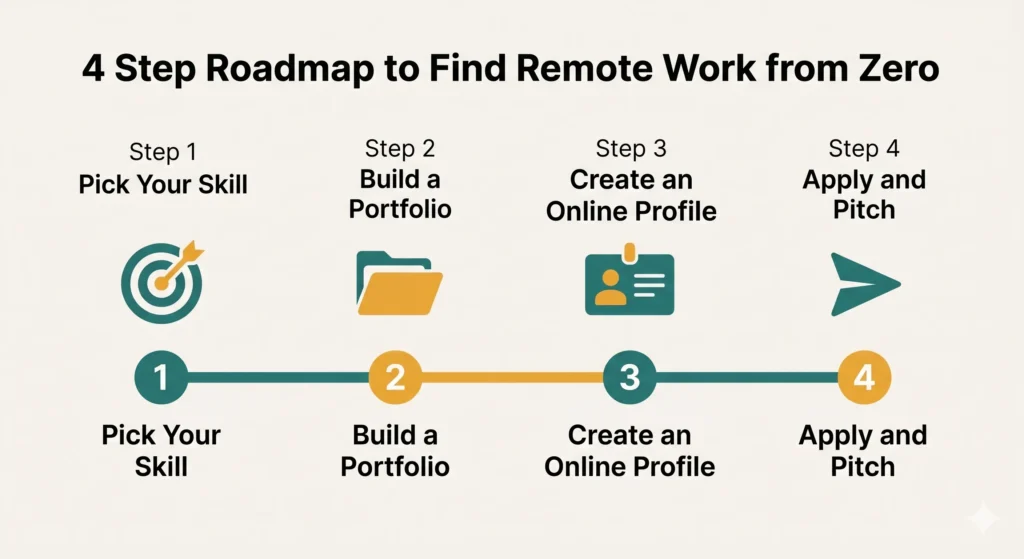
Pick One Skill and Go Deep
Generalists struggle when they’re unknown. Specialists get hired.
Choose one skill — just one — and commit to it for your first remote job search. If you can write clearly, go for content writing or copywriting. If you’re organized and detail-oriented, target virtual assistant roles. If you have design sense, try Canva-based social media content creation.
You don’t need to be the best. You need to be competent enough to deliver, and honest enough to communicate about your level. Clients who hire beginners know they’re hiring beginners. They’re paying for reliability and a willingness to learn — not perfection.
Spend 10–15 hours practicing your chosen skill. Create two or three sample pieces of work, even if no one paid you for them yet. These samples become your portfolio.
Create a Simple Online Presence
You don’t need a fancy website. You need a professional online profile that proves you’re a real person with real skills.
Start with LinkedIn. Make sure your headline reflects what you’re offering — not just your old job title. Something like “Freelance Content Writer | Remote Work Ready” tells a hiring manager exactly what to expect. Add a short summary that explains what you can do and who you can help.
Next, create a simple portfolio. Google Sites is free and takes about an hour to set up. Add your sample work, a brief bio, and your contact information. That’s your portfolio. Done.
If your skill is design-heavy, use Behance or a free Canva portfolio template. If it’s writing, a simple blog post on Medium works fine.
The goal isn’t to impress — it’s to exist. You need a professional digital footprint so that when a client Googles your name, something useful comes up.
Where to Find Remote Work (Without Getting Scammed)
The remote job space has plenty of legitimate opportunities — and more than a few traps. Knowing where to look (and what to avoid) saves you a lot of time and frustration.
Freelance Platforms for Beginners
For your first remote income, freelance platforms are the easiest on-ramp. Here are the ones worth your time:
Upwork is the largest freelance marketplace in the world. Competition is real, but so is the opportunity. Beginners should start with smaller projects and competitive rates to build their track record.
Fiverr lets you create service listings that clients browse and purchase. It works well for well-defined deliverables — a logo design, a 500-word article, a voiceover recording. Set up your gig, optimize the description with clear keywords, and be patient. The first sale takes time.
PeoplePerHour and Freelancer are smaller alternatives worth exploring, especially if you want less competition than Upwork while still accessing a global client base.
One rule: never pay to apply for a job or access a job listing. Any platform or posting that asks for an upfront fee is a scam. Legitimate platforms make money from commissions, not from job seekers.
Remote-First Job Boards
If you’d rather find part-time or full-time remote employment than freelance, these job boards specialize in remote roles:
We Work Remotely is one of the oldest and most respected remote job boards. It’s free to browse and lists roles across marketing, design, development, customer support, and more.
Remote.co curates verified remote positions from companies that are genuinely remote-first — not just pandemic-era hybrid arrangements rebranded as “remote.”
FlexJobs charges a small subscription fee but screens listings manually to remove scams. If you’re worried about wasting time on fake postings, it can be worth it for the peace of mind.
AngelList Talent (now Wellfound) is excellent if you’re open to startup culture. Many early-stage companies are fully remote and willing to take a chance on motivated beginners.
The Hidden Job Market — LinkedIn and Cold Outreach
Here’s something most beginners skip: a lot of remote work is never posted publicly.
Hiring managers often fill roles through their network before a job listing ever goes live. That means LinkedIn is not just a profile host — it’s an active job search tool.
Connect with people in your target industry. Comment meaningfully on their posts. Send a short, specific connection request. After a few interactions, a brief message saying “I’m exploring remote opportunities in [your skill area] — would love to stay connected” is not pushy. It’s professional.
Cold email is also underrated. Identify five to ten small businesses or content creators whose work you genuinely admire. Write a short email explaining what you do, what you noticed about their business, and one specific way you could help. Keep it under 150 words. Some will ignore you. A few will respond. One might hire you.
How to Land Your First Remote Gig
Finding the opportunity is half the battle. The other half is converting that opportunity into an actual yes.

Write a Proposal That Gets Read
Most beginner proposals look the same: “I am a hardworking professional with experience in X. I can deliver quality work on time. Please consider me for this project.”
That gets deleted.
A strong proposal opens with the client’s problem, not your resume. Start with something specific: “I noticed your blog hasn’t been updated in two months — I can help you stay consistent with weekly posts.” Then briefly explain why you’re the right fit. End with a clear, low-risk next step: “Happy to send a sample article on your topic if that would help.”
Short. Specific. Focused on them.
Start Small, Build Fast
Your first remote job isn’t about the money. It’s about the reference, the review, and the proof.
Accept a smaller project than you’d like. Deliver it faster than expected. Communicate clearly throughout. Ask for a testimonial when you finish.
That one review, that one five-star rating, that one LinkedIn recommendation — it changes everything. Suddenly you have something to point to. Your next proposal is 10 times stronger because it comes with proof.
Once you have three to five completed projects and strong reviews, you can raise your rates and become more selective. The beginning is about building the foundation, not maximizing income.
Set a simple 30-day goal: land one paid remote project. Not ten. Just one. That first yes is the hardest. Everything after is repetition and refinement.
What’s Next?
You’ve learned how to find remote work from scratch — now imagine building an entire lifestyle around that freedom. If you’re wondering whether remote work is realistic at a certain life stage, the next post answers exactly that.
👉 Read next: Digital Nomad in Your 50s: Why It’s Not Too Late to Start