
You’re in your 50s. You’ve been hearing about digital nomad in your 50s life for years — people working from Bali, Lisbon, Chiang Mai — and something in you keeps thinking: that could be me. Then another voice shows up immediately: it’s too late.
That second voice is wrong. And this post is here to prove it.
The nomad lifestyle isn’t owned by 24-year-olds with laptops and nothing to lose. It’s a working arrangement — and people in their 50s are often better positioned to make it work than people half their age.
Here’s why.

The Myth That Nomad Life Is Only for the Young
Open Instagram or YouTube and nomad content is dominated by young faces, backpacks, and hostel bunk beds. That’s the image. It’s not the reality.
The reality is that a growing number of people making the shift to location-independent work are over 40. Many are over 50. They’re not roughing it — they’re choosing comfortable apartments in affordable cities, building serious remote businesses, and living well on less than they spent back home.
The “nomad life is for young people” story exists because young people are louder about it online. That’s it.
Where the “Too Old” Story Comes From
Nobody sits you down and tells you that remote work has an age limit. But the message seeps in from everywhere — job postings that seem to target recent graduates, startup culture that celebrates youth, social media feeds full of people who look like they’re 25.
It’s a perception problem, not a reality problem. The companies hiring remote workers don’t care how old you are. Clients on Upwork or Fiverr don’t see your face. The café in Medellín where you’ll work on Tuesday morning doesn’t check your birth year before giving you the Wi-Fi password.
Age is largely invisible in remote work. That’s a feature, not a bug.
What You Actually Have That 25-Year-Olds Don’t
Think about what 25 years of working life gives you. Not just résumé lines — actual capabilities.
You’ve handled difficult clients without losing composure. You’ve navigated office politics, budget cuts, and failed projects. You’ve built relationships, managed teams, solved problems that didn’t come with instructions. You’ve learned how to communicate clearly when things get complicated.
A 25-year-old starting out as a digital nomad is figuring out work and independence and remote tools all at once. You’ve already solved most of those problems. You’re showing up with a full toolkit.
Real Advantages of Starting Later
Being a digital nomad in your 50s isn’t a compromise version of the lifestyle. In many ways, it’s the better version.
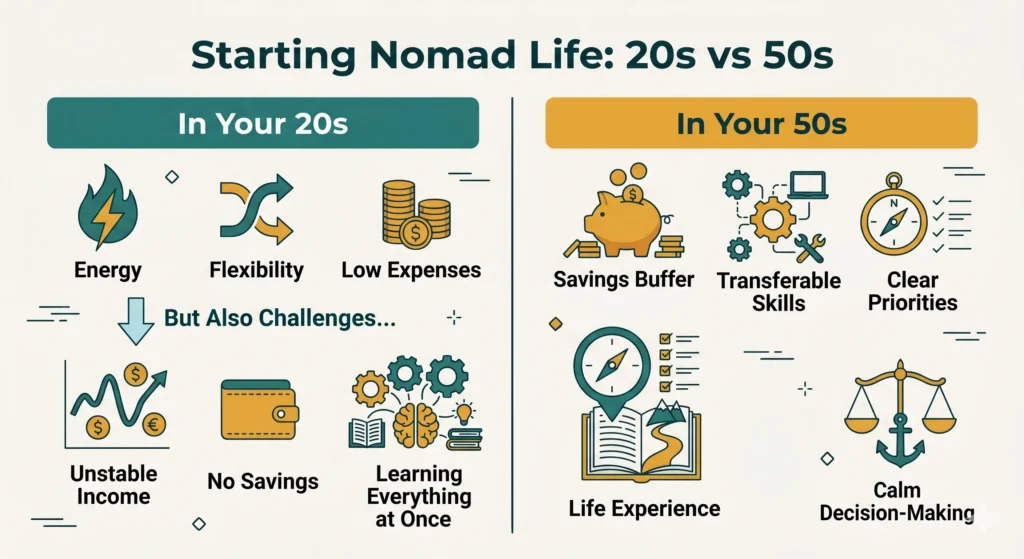
Financial Stability and Clearer Priorities
Most 50-somethings have something their younger counterparts don’t: a financial cushion.
Maybe it’s savings. Maybe it’s a pension that kicks in later. Maybe it’s a paid-off car or lower debt. Even a modest buffer changes everything when you’re building a remote income. You’re not desperate. You can afford to be patient, pick the right clients, and decline work that doesn’t fit.
You also know what actually matters to you by now. You’re not chasing some vague idea of freedom — you have specific things you want. More time with family. A slower pace. Mornings that belong to you. That clarity makes decisions easier and keeps you from getting distracted by every new shiny opportunity.
Decades of Transferable Skills
Whatever you spent your career doing — sales, marketing, management, teaching, finance, healthcare, writing, logistics — there is a remote version of that work.
Sales experience becomes consulting, coaching, or high-ticket freelancing. Marketing backgrounds translate directly into content creation, SEO work, or social media management for small businesses. Management skills make you valuable as a project manager or operations consultant. Teaching maps to online courses or tutoring.
The translation isn’t always obvious at first. But almost every traditional career skill has a remote counterpart. Your job is to find the bridge — and then cross it.
The Patience to Build It Right
This one is underrated.
Building a remote income takes time. Building a client base takes time. Building the confidence to work from a new country takes time. Young people often struggle with this. They want results fast. When results are slow, they quit.
People in their 50s tend to have more patience with process. They’ve seen careers built over years, not weeks. They know that slow progress is still progress. That mindset is a genuine competitive advantage in the remote work world, where most of the rewards go to people who stick around long enough to figure it out.
The Honest Challenges — and How to Handle Them
This wouldn’t be an honest post without acknowledging the real friction points. Being a digital nomad in your 50s has specific challenges. They’re manageable — but they deserve honest attention.
Health, Insurance, and Staying Well on the Road
This is the big one. Healthcare gets more complex as you get older, and traveling internationally adds another layer.
The good news: international health insurance for long-term travelers is widely available and often more affordable than people expect. Companies like SafetyWing, Cigna Global, and Allianz offer plans designed specifically for nomads and expats. Research your options before you leave, not after.
Beyond insurance, think about your personal health needs. Do you take regular medication? Make sure you can access it abroad — many common medications are available over the counter in countries where they require a prescription at home. Do you have specialist appointments scheduled? Build your travel plans around them, not against them.
Health is not a reason to stay home. It’s a factor to plan for. There’s a difference.
Tech Comfort and Keeping Up
You don’t need to be a tech wizard to work remotely. But you do need to be comfortable with the basics: video calls, cloud storage, project management tools, and communication platforms like Slack or Notion.
If any of those feel unfamiliar, spend a few weeks getting comfortable before you go. YouTube has tutorials for everything. Most tools have free plans. The learning curve is real but short — a few focused hours will get you functional on any platform you’re likely to need.
The tools change. What doesn’t change is your ability to learn new things — which you’ve been doing your entire career.
How to Start Your Transition Without Burning Everything Down

Test Before You Commit
You don’t have to quit your job tomorrow. You don’t have to sell everything and book a one-way flight to Southeast Asia. Most successful late-start nomads made the transition in stages — and that’s exactly the right approach.
Before going fully nomadic, take a test run. Book an apartment for a month in a city you’ve been curious about. Work your normal hours. See what it feels like to be productive in a new environment.
What you’ll probably discover: it’s easier than you imagined. The Wi-Fi works. The routine adjusts. The novelty wears off after a few days and you’re just… working. That’s the point. Remote work, done right, is just work — in a better location.
A 30-day test trip answers most of the questions that feel overwhelming from the outside. It’s worth taking.
Build Your Remote Income First
The most common mistake is treating nomad life as an escape from work instead of a different way of working. Before you change your location, secure your income.
That might mean negotiating a remote arrangement with your current employer. Many companies that required in-office work a few years ago are now flexible — especially for experienced, trusted employees. Ask directly. The answer might surprise you.
If employment isn’t the path, start building freelance work on the side while you still have your primary income. Spend 5–10 hours a week developing a skill, building a portfolio, and landing small projects. Do that for six months. By the time you’re ready to move, you’ll have real clients, real income, and real confidence.
The destination is exciting. But the income is what makes the destination sustainable.
What’s Next?
You’ve got the mindset and the plan — now it’s time to think about the gear. Working remotely while traveling means your laptop is your most important tool. In the next post, we break down exactly which lightweight laptops are worth carrying across borders.
👉 Read next: The Best Lightweight Laptop for Remote Work and Travel in 2026