
Nobody tells you what the first week actually feels like.
You expect a mix of freedom and fear. You get both. But you also get something nobody prepares you for: the complete absence of external structure. No meetings to slot into. No deliverables tied to someone else’s deadline. No calendar managed by other people’s urgencies.
For 25 years, I showed up when I was told to, worked on what was assigned, and moved at the pace of an organization. Then one day, none of that existed anymore.
Going from employee to solopreneur isn’t a single clean leap. It happens in slow, awkward, sometimes deeply uncomfortable phases — and the first 90 days are the most disorienting of all. This is an honest account of mine. Not the version that makes for a good LinkedIn post. The real one.

The Decision That Changed Everything
I didn’t leave my job because I had a plan. I left because staying had become more uncomfortable than going.
Twenty-five years in corporate sales and marketing. Mostly good work. Reliable income. Familiar routines. And then somewhere in year twenty-four, I realized I had stopped growing. I was maintaining, not building. Executing other people’s strategies, not designing my own.
The online income world had been in my peripheral vision for years — blogs, YouTube channels, people building audiences and earning from them. I’d dismissed it the way most people in corporate life do: as something other, younger, less-burdened people do.
What changed my mind wasn’t a sudden inspiration. It was math. I started calculating what it would actually take to replace even a portion of my salary with online income. The numbers were more reachable than I’d assumed — not easy, but not impossible either.
What Made Me Finally Walk Away
I resigned at the end of April. No backup income, no monetized blog, no established audience. Just a clear-eyed assessment that the cost of not trying had finally exceeded the cost of trying.
That’s the honest version. Not “I seized an opportunity.” More like: I ran the numbers on regret and the math came out in favor of leaving.
What I Got Wrong About the Transition
I assumed momentum would arrive naturally, like a second wind. It didn’t.
The first real collision with solopreneur life is the paralysis that comes with total freedom. I’d sit down at 9 a.m. — no meetings, no deliverables, no one waiting on me — and find myself two hours later having done productive-feeling things that moved nothing forward. Reading about SEO. Organizing folders. Watching tutorials about tools I wasn’t using yet.
The first real lesson: freedom requires more self-imposed structure than a job does, not less. Waiting to feel motivated is a slow way to fail. Structure comes first. The feeling follows.
Month One: The Messy Beginning
The first month wasn’t about income. It was about building containers — systems and habits that would hold the work once the work was actually happening.
Building Structure Before Building Income
I picked two projects: an English-language blog targeting global readers and a Korean-language blog for domestic audiences. Two platforms, two monetization strategies, one person running all of it.
The early mistake was obvious in hindsight: working on both simultaneously without a clear priority system. I’d draft two hours on one blog, context-switch to the other, and then realize at the end of the day I’d started three things and finished none.
What fixed it was a simple weekly output rule. Not a theme, not a goal — a specific deliverable. One published post. One setup task fully completed. One tool researched and tested. Small, verifiable units of output that I could look at and say: that happened this week.
I also started using AI tools — Claude, ChatGPT, Gemini — not as replacement writers but as thinking partners. They helped me move from vague intentions to actual structures with clear angles and focus keywords. That shift alone saved me weeks of staring at blank documents.
The First Real Win (And What It Actually Felt Like)
Three weeks in, I published my first real blog post. Not a test post, not a placeholder — a properly structured piece with a focus keyword, heading hierarchy, original content, and images.
I hit publish at 11 p.m. on a Tuesday and felt nothing except tired.
That was the win. Not a traffic spike. Not a comment from a stranger. Just the simple, unglamorous act of finishing something publishable and actually publishing it. The first unit of real work in this life is smaller and quieter than the internet makes it look — and that’s okay.
Month Two: Finding a Rhythm
By the second month, the early paralysis had mostly cleared. The work didn’t look glamorous, but it had a shape I could recognize from day to day.
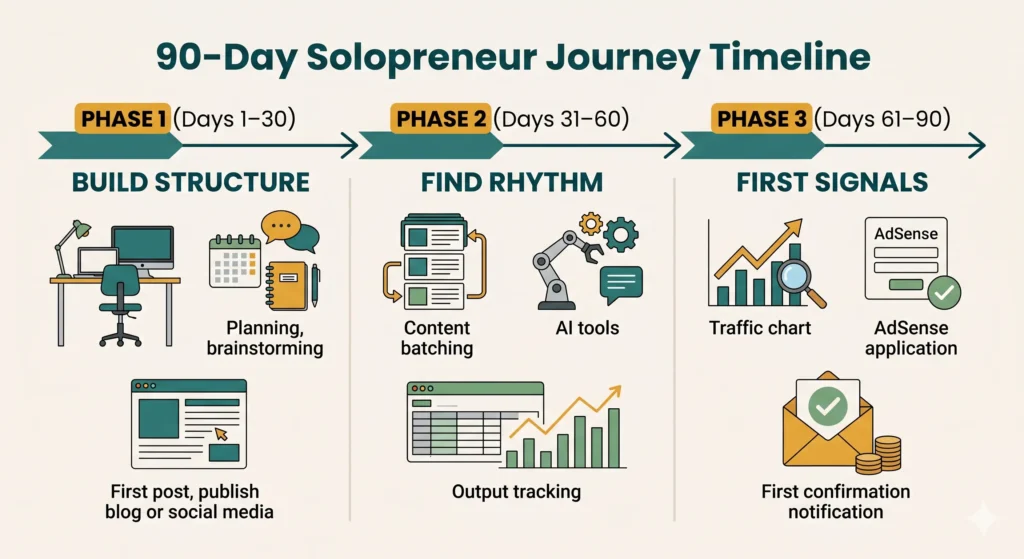
What Actually Started Working
Batching. Writing two or three posts in a single sitting rather than spreading one post across three days. The mental startup cost of getting into writing mode is high — once inside it, staying is far easier than leaving and re-entering.
AI-assisted research compressed what used to be a half-day task into under an hour. I’d use AI tools to outline a topic, identify the angles worth covering, and surface the questions a real reader would bring. Then I’d write the actual post myself — my voice, my editorial judgment, my specific examples.
The second thing that stuck: treating content output as a non-negotiable weekly number rather than an aspiration. Two posts per week. Every week. Missing one wasn’t a crisis, but the number existed, and it kept the work from gradually dissolving into vague intention.
The Mistake That Cost Me Three Weeks
I spent three weeks in month two deep in research on monetization options that had no relevance to where I actually was. Affiliate networks, newsletter sponsorships, direct ad deals — options that require audience volume, traffic history, and platform credibility I hadn’t built yet.
The cost wasn’t just three weeks. It was three weeks of zero publishing.
The lesson, learned expensively: monetization follows content. Not the other way around. In the early phase, the only job is publishing consistently. Everything else is a future problem.
Month Three: The First Confirmation
Month three is where the story is supposed to get tidy. Momentum builds, early income arrives, the creator realizes they made the right call. Mine was messier than that.
When the Numbers Started Making Sense
Traffic started moving — not dramatically, but measurably. Posts that had been sitting at single-digit pageviews began accumulating small, steady numbers. Search engines were starting to recognize the blog as a real, consistent presence rather than a new domain with a handful of scattered pages.
Toward the end of month three, I submitted for Google AdSense review. Meeting the requirements — enough original content, proper site pages, clean structure, consistent publishing — had consumed most of the previous months to get right. The approval email arrived on a Tuesday morning. I read it three times. Then went to make coffee and didn’t do much productive for the rest of that day.
That’s what the first confirmation moment actually feels like. Not euphoria. Not vindication. Something quieter: the model works. The structure holds. The rest is iteration.
What I’d Do Differently From Day One
Publish faster and care less about perfection early on. A solid post live today is worth more to a new blog’s growth than a polished post live next month. Search engines need volume before they give you authority.
Start a tracking system immediately. Even a basic spreadsheet — publish date, word count, traffic by post — takes ten minutes to set up and becomes enormously useful four months later when you need to understand which content is actually working.
Stop consuming so much content about the solopreneur life. The people writing about freedom and passive income have largely already built it. Reading their retrospectives is motivating for about a week and quietly misleading after that.
What the Highlight Reel Doesn’t Show
Nobody posts about the Tuesday afternoon where nothing worked. The week where every draft felt forced and hollow. The 2 a.m. moment in month two where you wonder — seriously, not rhetorically — whether you made the right call.
Those happen. Regularly, in the first 90 days.
The transition from employee to solopreneur is not a clean leap into a better life. It’s a slow, uneven climb with long stretches where progress is invisible. The freedom is genuine. So is the sustained uncertainty. The income is genuinely buildable. So is the extended period before it meaningfully materializes.

What got people through it — what’s getting me through it — isn’t optimism or boldness or a particularly good strategy. It’s a very boring, unsexy commitment to doing the small unit of work again the next day.
Ninety days in, I hadn’t replaced a full income. I had built a content structure, earned the first signal that the direction was right, and developed the working habits that the next phase would run on.
That’s what the first 90 days as a solopreneur actually produces. Not transformation. Foundation. It turns out that’s exactly enough.
What’s Next?
Once the foundation is in place, the next question becomes obvious: how do you build income streams that work even when you’re not actively creating? The next post looks at passive income streams you can build with AI — from content systems that compound over time to digital products that sell while you sleep.
👉 Read next: Passive Income Streams You Can Build With AI in 2026