
You’ve just finished your first digital product. Maybe it’s a template pack, an e-book, or a quick-start guide you’ve been sitting on for months. The hard part is done — you created something. Now you’re staring at a list of platform names wondering which one actually makes sense for you.
This is where a lot of new creators get stuck. Gumroad, Payhip, and Stan Store all look similar at first glance. But the differences in fees, features, and audience fit are real — and choosing wrong can cost you money before you’ve made a single sale.
If you’re ready to sell digital downloads for the first time in 2026, this post gives you a straight comparison. No vague impressions, no sponsored takes. Just fees, features, and which platform is genuinely built for your situation.

Why Your Platform Choice Actually Matters
Most new creators pick a platform based on what a blogger or YouTuber recommended. That’s not a bad starting point — but their situation probably looks different from yours. Volume, audience, and product type all change the calculus.
Hidden Fees Can Quietly Cut Into Your Revenue
Every platform takes a cut. The structure just varies. Some charge a flat percentage of every transaction. Others charge a monthly subscription instead. A few do both in certain plans.
The difference matters more than you’d expect. Say you’re selling a $20 e-book and move 100 copies in your first month — that’s $2,000 in gross revenue. A 10% transaction fee costs you $200. A 5% fee costs $100. A flat $29/month subscription with zero fees costs $29. Same revenue, very different outcome.
Before you commit to a platform, estimate your expected monthly volume. The math will tell you more than any feature comparison ever will.
Four Things to Compare Before You Commit
When evaluating any platform to sell digital downloads, focus on these four criteria:
Transaction fees — what percentage they take per sale
Monthly subscription cost — whether one exists and at what tier
Supported product types — files, memberships, courses, subscriptions, coaching
Built-in tools — email capture, affiliate programs, checkout customization, VAT handling
With that framework, here’s how the three platforms actually stack up.
Gumroad — Simple, Trusted, and Battle-Tested
Gumroad has been around since 2011. It’s the most recognizable name in the creator commerce space, used by hundreds of thousands of people — indie writers, designers, solo software developers, and everyone in between.
What Gumroad Gets Right
Setup is faster than any other platform on this list. You can have a product live and accepting payments in under 15 minutes. And because there’s no monthly fee, there’s no financial risk while you’re still testing whether your product actually sells.
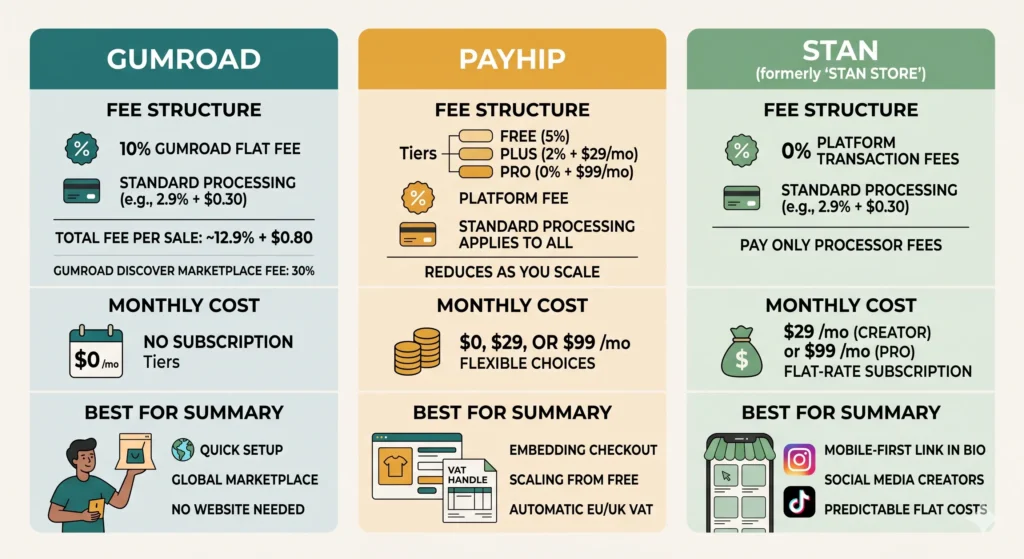
Gumroad charges a flat 10% transaction fee on every sale. No hidden charges, no plan tiers to navigate, no confusing upgrade paths. You know exactly what you’re paying from day one.
The platform supports a wide range of product types: digital files, memberships, pay-what-you-want pricing, software license keys, and physical products. The built-in Gumroad Discover marketplace also gives your listings a shot at organic exposure — real buyers browse the platform looking for products, without you spending a dollar on ads.
EU VAT is handled automatically, which is a real convenience if you’re selling to an international audience and don’t want to manage tax compliance yourself.
Where Gumroad Lets You Down
The 10% fee is the number that stops many creators cold. At low volume, it feels manageable. At $5,000/month in revenue, you’re effectively handing over $500 — every month — with no option to reduce it through a paid plan.
Storefront customization is also limited. Your product page will look like a Gumroad page. If brand presentation matters to you, you’ll need your own website pointing to Gumroad rather than relying on the platform for your identity.
Payouts are processed through PayPal or Stripe and can take a few business days. Not a dealbreaker, but worth knowing.
Payhip — The Most Flexible Fee Structure
Payhip is less talked-about than Gumroad, but it deserves more attention. If you’re budget-conscious and want room to grow without being penalized for your own success, Payhip’s tiered pricing is genuinely smart design.
What Payhip Gets Right
The free plan comes with a 5% transaction fee — already half of Gumroad’s cut. As your revenue grows, the upgrade path is logical: $29/month drops the fee to 2%, and $99/month eliminates transaction fees entirely.
This means Payhip scales with you without forcing a commitment up front. Start free, build revenue, then upgrade when the math actually favors it.
One feature that genuinely stands out: PDF stamping. Every PDF download is automatically watermarked with the buyer’s name and email. If your e-book shows up on a piracy site, you can trace it back to the original purchaser. For knowledge product creators, that’s meaningful protection.
Payhip also includes a built-in affiliate program at no extra charge. You can let others promote your products and earn a commission — no third-party integrations needed. EU VAT compliance is handled automatically, and the platform supports digital downloads, online courses, memberships, coaching bookings, and physical products, all from one dashboard.
Where Payhip Falls Short
The interface is functional, but the design feels dated compared to Stan Store. The storefront and checkout experience are less polished, which can affect how buyers perceive your brand.
Organic discovery is limited. Unlike Gumroad’s marketplace, Payhip doesn’t have buyers actively browsing for products. You’re entirely responsible for driving your own traffic.
If you’re building a social media-driven audience and want your storefront to double as a link-in-bio page, Payhip isn’t designed for that workflow.
Stan Store — Built for the Social Media Creator
Stan Store launched in 2022 and grew quickly — specifically among Instagram and TikTok creators. The pitch is clear: replace your messy link-in-bio with one clean, all-in-one storefront.
What Stan Store Gets Right
Stan Store charges a flat monthly subscription — $29/month for the Creator plan, $99/month for Creator Pro — with zero transaction fees on digital product sales.
At volume, that math is compelling. Earn $3,000/month in digital downloads and you’re paying $29 flat. With Gumroad’s 10% fee, the same revenue costs $300. The break-even point between Stan Store and Gumroad is roughly $290/month in sales. Once you pass that number, Stan Store saves you money — assuming you’re already generating traffic.
The platform is designed around the social media selling flow. Your Stan page works as a link-in-bio replacement — link it directly from your Instagram or TikTok bio, and visitors land on a page where they can buy your products, book a call, join a course, or subscribe to your email list. All in one place.
The checkout is mobile-first and clean. For a social media audience viewing on their phones, that frictionless experience meaningfully improves conversions.
Where Stan Store Falls Short
The monthly subscription is a real barrier for beginners with unvalidated products. Paying $29/month before you’ve made your first sale is a commitment — not a rounding error.
Stan Store is purpose-built for social media creators. If you don’t have an active presence on Instagram or TikTok, you won’t get full value from the platform. It’s not a marketplace. There’s no organic discovery. Traffic has to come from you.
Long-term SEO is also not a strength. Stan Store works when social media is already working. It amplifies what you’ve already built — it doesn’t replace building it.

Head-to-Head: Quick Fee Comparison
Here’s how the numbers break down at three different monthly revenue levels in 2026:
At $500/month in sales:
Gumroad (Free): $50 in fees
Payhip (Free): $25 in fees
Stan Store Creator: $29 flat
At $1,500/month in sales:
Gumroad (Free): $150 in fees
Payhip (Free): $75 in fees
Payhip Plus: $29 subscription + $30 fee = $59 total
Stan Store Creator: $29 flat
At $5,000/month in sales:
Gumroad (Free): $500 in fees
Payhip Pro: $99 flat
Stan Store Creator: $29 flat
The pattern is clear. At low volume, Payhip’s free plan beats Gumroad on cost. At medium to high volume, Stan Store wins on price — but only if social media is already driving your sales. If it isn’t, you’re paying $29/month for a platform with no built-in audience.
Note: Platform pricing can change. Always verify current fee structures before signing up.
Which Platform Should You Use?
Here’s the honest summary.
Choose Gumroad if you want zero financial commitment, the fastest possible setup, and a chance at organic discovery through the platform’s marketplace. It’s the right starting point for writers, designers, and creators who want to sell digital downloads without any monthly overhead. The 10% fee stings at scale, but it removes every barrier to launching quickly.
Choose Payhip if you’re selling PDF-based products and want built-in piracy protection, or if you want the flexibility to start free and upgrade only when revenue justifies it. It’s also the stronger choice for EU sellers who need reliable VAT compliance and want a native affiliate program without paying for extra tools.
Choose Stan Store if you’re already active on Instagram or TikTok and want a clean, mobile-optimized storefront that functions as your link-in-bio. The flat monthly fee makes financial sense once you’re past $290/month in sales, and the all-in-one experience — products, bookings, email, courses — removes a lot of operational complexity.
All three are legitimate, proven ways to sell digital downloads in 2026. The best platform isn’t the one with the most features — it’s the one you’ll actually launch on this week, without talking yourself out of it first.
What’s Next?
Choosing the right platform is a practical decision you can make in an afternoon. But the bigger shift — from employee thinking to solopreneur operating — takes longer and looks messier than most people admit. In the next post, we get honest about what the first 90 days of earning online actually look like.
👉 Read next: From Employee to Solopreneur: My First 90 Days Earning Online