
You land in Bangkok. You turn on your phone. And you watch your carrier charge you $15 for a single day of “international data.”
That feeling? It should be illegal.
If you’re a remote worker or digital nomad who crosses borders regularly, eSIM cards have already changed the game. No physical SIM swaps. No hunting for a local store the moment you land. No surprise roaming bills at the end of the month.
But here’s the problem: there are dozens of eSIM providers now, and they all claim to be the best. Data speeds vary wildly. Coverage maps lie. Pricing structures are confusing.
This guide cuts through all of it. I reviewed the top eSIM cards for international remote workers so you can pick the right one before your next trip.

Why Remote Workers Need an eSIM
What Is an eSIM and How Does It Work?
An eSIM is a digital SIM card built directly into your device. Instead of inserting a physical chip, you scan a QR code or download a profile. Your phone connects to a local carrier network in whatever country you’re in — without you needing to do anything else.
Most modern smartphones support eSIM: iPhone XS and later, Google Pixel 3 and later, and most Samsung Galaxy S and Z series from 2020 onward. If you’re not sure, check your device settings under “Mobile Data” or “SIM Management.”
The big advantage for remote workers isn’t just convenience. It’s control. You keep your home number active for calls and SMS while running a separate eSIM data plan for internet. Two lines, one device, zero SIM-swapping drama.
The Real Cost of Roaming Without One
Standard international roaming from major carriers typically runs $10–$15 per day per country. For a month-long trip through three countries, you’re looking at $300–$450 in data fees — before you’ve opened your laptop once.
Even “affordable” roaming packages rarely give you the speeds you need for video calls and file uploads. eSIM cards from dedicated providers give you local network speeds at a fraction of the price. A typical 10GB plan for Southeast Asia costs around $10–$18. That’s not per day. That’s for the whole trip.
How I Evaluated These eSIM Cards
I tested each provider across four criteria:
Coverage: How many countries are supported? Is the coverage real, or just “partner network” with throttled speeds?
Data speed: Actual download speeds on local networks, not theoretical maximums.
Price per GB: Normalized pricing so you can compare apples to apples.
Ease of setup: How fast can you activate from the moment you land?
I focused on providers that are genuinely useful for people who work while traveling — not just tourists checking maps for a week.
The Best eSIM Cards for International Remote Workers
Airalo — Best Overall for Multi-Country Coverage
Airalo is the most widely recognized name in the eSIM space, and for good reason. It supports over 200 countries and regions, with both single-country plans and regional packages that cover entire continents.
For a remote worker hopping between multiple countries in a single trip, the regional plans are the real value here. Their Europe plan covers 39+ countries starting around $5 for 1GB. Their Global plan covers 100+ countries — useful if you’re genuinely moving around a lot.
Pros: Massive country coverage. Clean app. Straightforward activation.
Cons: Data-only (no calls or SMS). Prices per GB get high on short-trip plans.
Best for: Frequent multi-country travelers who want one eSIM that works almost everywhere.
Holafly — Best for Unlimited Data
If you’re doing heavy work — video calls all day, uploading large files, joining Zoom meetings from a café — Holafly’s unlimited data plans are worth looking at seriously.
Holafly operates with unlimited data plans in over 150 countries. The catch is that speeds are sometimes throttled after heavy usage, and “unlimited” doesn’t always mean full-speed unlimited. That said, for most remote work tasks, it holds up well.
Pricing is higher than pay-per-GB options. A 30-day unlimited plan for Europe runs around $47. For the US, it’s closer to $55. If you’re there for a month and need consistent connectivity, the math works out.
Pros: Unlimited data removes the anxiety of tracking usage. Good for extended stays.
Cons: Pricier than competitors. Speed throttling reported in some regions.
Best for: Remote workers staying in one country for 2–4 weeks with heavy data needs.
Nomad — Best for Asia-Pacific Travel
Nomad is a strong pick specifically for the Asia-Pacific region, where it has negotiated solid deals with local carriers. Coverage in Japan, South Korea, Thailand, Vietnam, Singapore, and Australia is notably good — and their prices per GB are some of the most competitive in this region.
A 10GB Japan plan runs around $9. A 20GB Southeast Asia regional plan is approximately $18. Those are genuinely good numbers.
Their app is clean, activation is fast (usually under two minutes), and customer support responds quickly via chat.
Pros: Excellent Asia-Pacific coverage and pricing. Fast activation.
Cons: Less competitive outside APAC. Fewer global plan options.
Best for: Digital nomads based in or traveling through Asia.
Maya Mobile — Best for Latin America
Latin America is a blind spot for most major eSIM providers. Coverage is often thin or routed through expensive partners. Maya Mobile fills this gap with dedicated plans for Mexico, Colombia, Brazil, Argentina, and other key destinations.
If you’re working from Medellín, Mexico City, or Buenos Aires for a month, Maya Mobile will likely serve you better than Airalo or Holafly for that specific region. Plans are reasonably priced, and the local network connections are reliable in urban areas.
Pros: Best Latin America coverage among dedicated eSIM providers.
Cons: Limited usefulness outside Latin America. App is functional but basic.
Best for: Remote workers in Latin America or planning extended stays there.
Saily — Best Budget Pick
Saily is a newer entrant from the makers of NordVPN. It supports over 150 countries and competes aggressively on price. It doesn’t win in any one specific category, but if you want solid coverage at the lowest possible cost and you’re not going to extreme off-the-grid locations, Saily delivers.
Short-trip plans start around $1.99 for 1GB in popular destinations. That’s one of the lowest entry points in the market. A 10-day Europe plan with 10GB runs around $12.
Pros: Very competitive pricing. Easy setup. Backed by a reliable tech company.
Cons: Newer brand — less long-term track record. Coverage depth varies by country.
Best for: Budget-conscious remote workers or those trying eSIM for the first time.
eSIM Cards Compared: Quick Reference Table
Here’s the simplified breakdown to help you decide quickly:
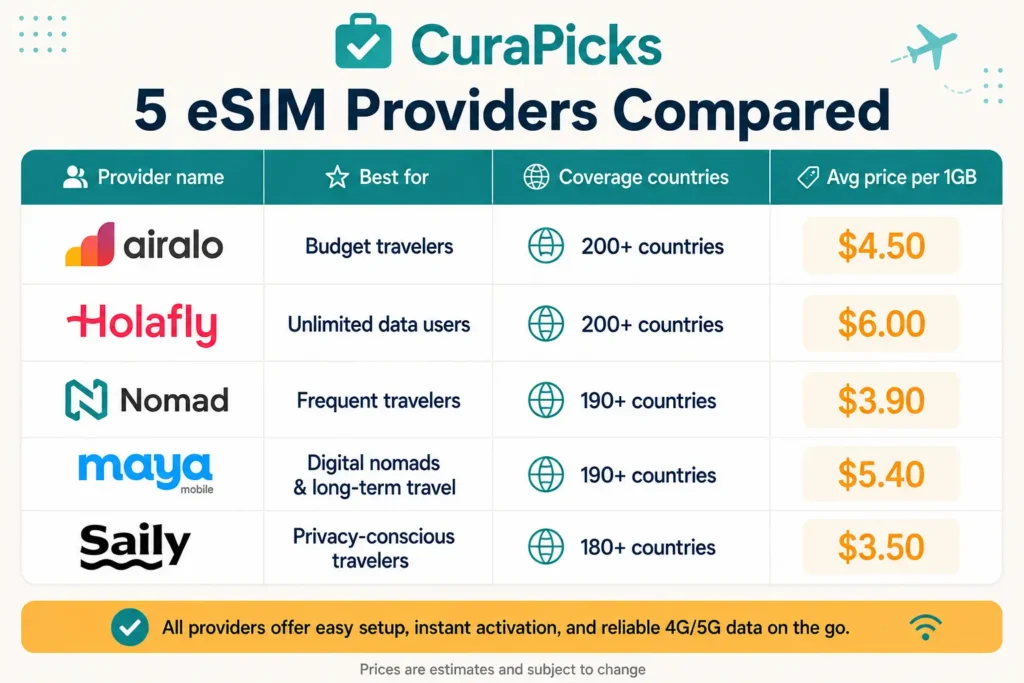
Airalo — Best for multi-country trips | 200+ countries | Approx. $3–$8/GB
Holafly — Best for unlimited data, extended stays | 150+ countries | Flat unlimited pricing
Nomad — Best for Asia-Pacific travel | 80+ countries | $1–$3/GB in APAC
Maya Mobile — Best for Latin America | 40+ countries (LatAm focus) | $3–$6/GB
Saily — Best for budget travelers | 150+ countries | $2–$5/GB
Prices are approximate and vary by country and plan duration. Always check the provider’s app for current rates before purchasing.
Which eSIM Should You Choose?
Here’s the honest shortcut:
You travel across multiple continents regularly? Get Airalo. The coverage breadth is unmatched, and the regional plans make it practical.
You stay in one country for weeks at a time with heavy data usage? Holafly’s unlimited plan is worth the premium.
You’re based in or traveling through Asia? Start with Nomad. Their APAC pricing is the best in class.
You’re working from Latin America? Maya Mobile is your most reliable option.
You’re new to eSIM and want to try it cheaply? Saily gets you started without a big commitment.
One more practical note: most eSIM cards are data-only. You keep your home SIM for calls and texts, which most remote workers prefer anyway. If you need a local number for calls, check whether the provider offers a calling add-on before purchasing.
Also — always activate your eSIM before you land. Download the profile while on your home Wi-Fi. The last thing you want is to be standing in an airport trying to scan a QR code with no internet connection.
The bottom line: eSIM cards are not optional for serious remote workers anymore. They’re as essential as your laptop charger.
What’s Next?
Once you’ve sorted your connectivity with the right eSIM, the next piece of the puzzle is your actual workspace setup. Whether you’re working from a hotel room, a co-working space, or a café, your gear and setup matter more than most people realize.
👉 Read next: How to Set Up a Productive Work-From-Anywhere Setup for Under $500