
You built the blog. You wrote the posts. You set up the pages.
Then you applied for AdSense — and got rejected.
Or maybe you haven’t applied yet, and you’re not sure if you’re ready. Either way, you’re in the right place.
If you’ve been searching for a Google AdSense approval checklist that actually works, you’re in the right place. Getting approved can feel like cracking a secret code. You apply, get rejected, wonder why, then try again. The frustrating part? The rejection emails are vague. “Insufficient content.” “Site does not comply with Google policies.” What does that even mean?
This post breaks it all down. No guesswork, no recycled advice — just a clear, honest checklist based on what actually works in 2026.

Why Most Bloggers Get Rejected (It’s Not What You Think)
Most people assume AdSense rejection means their blog isn’t good enough. That’s rarely the whole story.
Many beginners fail due to simple, avoidable mistakes — not because their content is bad, but because they applied too early or skipped essential setup steps. YouTube
The most common reasons for rejection in 2026 come down to four things: not enough quality content, missing required pages, a site that looks unfinished, and policy violations the applicant didn’t even know existed.
The good news? Every single one of those is fixable. And once you fix them, approval is genuinely achievable — even on a brand new blog.
The Non-Negotiables: What Google Actually Checks
Content — quality over quantity, but quantity still matters
The phrase “insufficient content” in a rejection email usually means weak value or structure — not only a low post count.
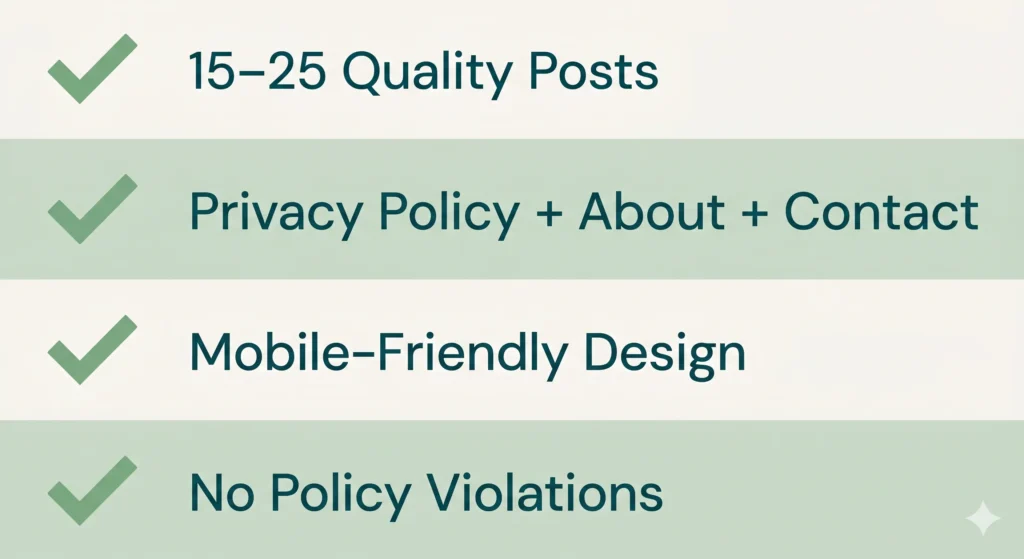
That said, you do need enough posts to demonstrate that your blog is a real, active project. Aim for 15 to 25 quality posts with original, helpful content before applying. Each post should answer a specific question your reader is actually asking — not just fill a word count.
What Google’s reviewers are looking for is simple: does this blog help real people? Is the content written for humans, or does it feel generated and hollow? Is there a clear voice and perspective behind it?
If the answer to those questions is yes, you’re on the right track.
One thing to keep in mind: don’t publish 20 near-identical posts targeting the same topic. Publishing many similar posts targeting the same keyword can actually hurt your chances. Variety within your niche signals that you’re building a real resource, not gaming the system.
The four pages you absolutely must have
This is the step most new bloggers miss — and it’s one of the fastest ways to get rejected.
Before requesting AdSense review, your site must have a Privacy Policy, Terms of Service, Contact page, and About page — all easily accessible from your header or footer navigation.
Each of these serves a purpose. Your Privacy Policy tells Google (and your readers) how you handle data. Your About page proves there’s a real person behind the blog. Your Contact page shows you’re reachable. Your Terms page covers legal bases.
Don’t skip these. Don’t bury them. Make sure they’re linked clearly in your site footer — Google’s reviewers check this manually.
Technical basics Google won’t overlook
Your content can be excellent, but if your site is slow, broken, or impossible to navigate on a phone, you’re making the reviewer’s job harder — and that rarely ends well.
Over 70% of AdSense reviewers check the mobile view first. Your site needs to load cleanly on a smartphone, with no overlapping text, broken images, or layout issues.
Beyond mobile, make sure your site loads quickly. A lightweight theme like GeneratePress combined with a caching plugin handles most of this automatically. Also check for broken links and make sure every page in your navigation actually works.
The Stuff Nobody Tells You
Your domain age matters more than you’d expect
Google views domain age as a critical trust signal. Aim for a domain that is at least 3 to 6 months old before applying — new bloggers often make the costly mistake of buying a domain, writing a few posts, and immediately applying for AdSense.
This doesn’t mean you have to wait six months doing nothing. Use that window to build your content foundation, set up Google Search Console, and get your technical setup right. By the time you apply, your site will look like a real, established project — not a weekend experiment.
AI-written content — where’s the line?
This is the question everyone is asking in 2026, and the honest answer is: it depends on how you use it.
AI content can be approved only if it is well-edited, helpful, original, and written for users — not thin or spammy. Google isn’t flagging AI assistance outright. What it flags is low-effort, generic content that provides no real value — which happens to be what you get when you take AI output and publish it without editing.
Use AI as a drafting tool, not a publishing tool. Add your own perspective, examples, and voice. If the post reads like it was written by a real person with real experience, it will pass review. If it reads like it was generated in thirty seconds, it won’t.
Traffic is not required (but this is)
Good news for new bloggers: traffic is not mandatory for AdSense approval. Many new blogs with little or no organic traffic get approved if all requirements are met.
What is required is that your traffic looks natural. Don’t buy clicks, don’t inflate your numbers with bots, and don’t run any paid campaigns just to juice your stats before applying. Google can detect artificial traffic patterns, and getting caught doing this doesn’t just hurt your approval chances — it can get your account banned entirely.
The Complete Pre-Application Checklist
Go through every item below before you hit submit. If anything isn’t checked, fix it first.
Content
- 15 to 25 original, well-written posts published
- Each post answers a specific reader question
- No copied, plagiarized, or purely AI-generated content
- Posts cover a focused niche — no random topic mixing
Required Pages
- Privacy Policy (mentioning Google AdSense and cookies)
- About page (who you are, who the blog is for)
- Contact page (working email or contact form)
- Terms of Service
Technical
- Custom domain with HTTPS enabled
- Mobile-responsive design
- Site loads in under 3 seconds
- No broken links or 404 errors
- Google Search Console connected and sitemap submitted
Policy Compliance
- No adult, gambling, or prohibited content anywhere on the site
- No copyright violations (images, text, or media)
- No “coming soon” pages or placeholder content
- Navigation is clear — any page reachable within three clicks
If everything above is checked, you’re ready to apply with confidence.

What Happens After You Apply?
Once you submit, Google’s review process typically takes anywhere from a few days to two weeks. Sites that meet all the criteria tend to get approved within 3 to 5 days on average.
During review, keep publishing. Keep your site stable. Don’t make major structural changes while the review is in progress — it can reset the clock.
You’ll receive an email either confirming approval or explaining the reason for rejection. If it’s the latter, read that email carefully. Google groups rejections into a small number of categories, and the category tells you exactly what to fix.
Got Rejected? Here’s Exactly What to Do
First: don’t reapply immediately. Wait at least 7 to 14 days before reapplying, and use that time to fix the specific issues mentioned in the rejection email. Multiple quick reapplications can hurt your future chances significantly.
Second: map the rejection reason to the checklist above and fix every item in that category — not just the obvious one. Rejections are often caused by a combination of small issues rather than one big problem.
Third: keep publishing two or three posts during the waiting period. It shows Google your blog is active and growing, not abandoned after a rejection.
One Last Thing Before You Hit Apply
AdSense approval isn’t the finish line. It’s the starting line.
Getting approved means you can start earning from your traffic — but the real work is building the traffic worth earning from. Keep writing. Keep improving. The blogs that earn meaningfully from AdSense aren’t the ones that rushed the application. They’re the ones that built something worth reading first.
You’ve done the work. Now go get approved.
What’s Next?
Once AdSense is approved, the next income layer to add is affiliate marketing. But there’s a right way to do it — and a wrong way that kills reader trust fast.
In the next post, I break down exactly how affiliate marketing works for bloggers, which programs are worth joining, and how to recommend products without sounding like a sales pitch.
👉 Read next: Affiliate Marketing for Bloggers: The Honest Beginner’s Guide