
You’ve decided to leave the fixed address behind. Now the harder question: where, exactly?
The list of countries welcoming remote workers has exploded in recent years. More than 65 countries have launched visa programs specifically designed for remote workers in 2026 — from Southeast Asia to Southern Europe to Latin America. The options are genuinely overwhelming.
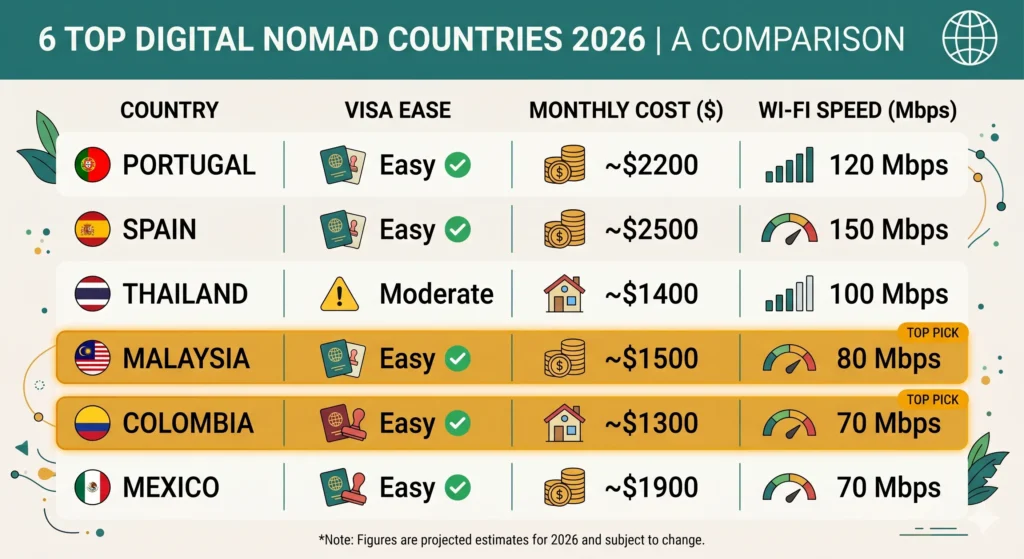
This post cuts through the noise. Six destinations that consistently work well for the best countries for digital nomads across three regions — evaluated on the three things that actually matter: visa accessibility, honest cost of living, and internet reliability.
No fluff. No destination that looks great in photos but has spotty 4G outside the capital.

How to Actually Choose a Destination
Before you look at any specific country, get clear on your own criteria. Four questions narrow the list fast:
What’s your monthly budget? Southeast Asia and Latin America can sustain a comfortable lifestyle on $1,200–$1,800 per month. Western Europe typically starts at $2,500–$3,500 and climbs quickly.
What time zone do you need to work in? Latin America aligns naturally with North American clients. Southeast Asia is ideal if your work is async or your clients are European.
Do you need a formal visa or will tourist entry work? Many nomads operate on tourist visas and 90-day allowances. Others need a legal, longer-term path — for banking, taxes, or peace of mind.
How long do you want to stay? Short-term explorers need different infrastructure than nomads planning a 12-month base.
Answer those four questions first. Then use this guide.
Europe: The Best of Both Worlds
Portugal — The Reliable Favorite
Portugal keeps appearing at the top of every list of best countries for digital nomads for good reason. It delivers quality of life, safety, a functioning visa program, and access to the rest of the Schengen zone — all from a base that’s genuinely livable rather than just Instagram-friendly.
Cities like Lisbon and Porto offer strong infrastructure, vibrant communities, and a balanced lifestyle. Internet speeds are reliable, coworking spaces are widely available, and coastal towns like Ericeira and Lagos are also becoming hotspots for remote workers.
The visa: Portugal’s D8 Digital Nomad Visa is the formal route for non-EU nationals. The income threshold in 2026 is set at €3,680 per month — four times Portugal’s current minimum wage. The visa grants up to one year of residency with renewal options. The application process is well-documented, though processing times can stretch.
Cost of living: A single remote professional in Lisbon can expect to spend roughly $2,700–$3,400 per month for a typical setup — a central apartment, coworking access, and regular meals out. Porto and smaller coastal towns run 20–30% cheaper.
Internet: Reliable fiber in major cities, averaging around 150 Mbps. Café Wi-Fi is generally solid.
Best for: Nomads who want an EU base with a clear legal pathway, safety, and community.
Spain — More Options Than You Think
Spain often gets overlooked in favor of Portugal, which is a mistake. Spain offers excellent value for money compared to many Western European countries, and its regional diversity means digital nomads can choose a city that fits their budget, pace, and work style — Barcelona for beach life and startups, Madrid for a fast-paced professional scene, Valencia for affordability and coast, and Málaga for sunshine year-round.
The visa: Spain launched its own Digital Nomad Visa, giving remote workers from outside the EU a legal residency path. The visa requires private health insurance valid throughout your stay, and Spain has strong internet infrastructure with a variety of coworking spaces that typically offer free Wi-Fi.
Cost of living: More variable than Portugal. Valencia and Málaga are genuinely affordable for Western Europe. Barcelona and Madrid sit closer to Portugal’s Lisbon price range.
Best for: Nomads who want a Southern European lifestyle but prefer more city variety within one country.
Southeast Asia: Low Cost, High Output
Thailand — Still the King for a Reason
Thailand has been the benchmark destination for best countries for digital nomads for over a decade. The infrastructure has kept pace with the demand.
The visa: Thailand launched its Destination Thailand Visa (DTV) in June 2024 — a 5-year multiple-entry visa designed for remote workers. It costs 10,000 THB (approximately $280 USD) and requires proof of remote income of $16,000 per year from outside Thailand. That makes it one of the most accessible long-stay visa options in the world by cost.
Cost of living: A realistic comfortable budget in Chiang Mai for 2026 runs $1,000–$1,500 per month for a single digital nomad — covering a private apartment, coworking access, and eating out regularly. Bangkok costs more, running $1,800–$3,000 for a comparable lifestyle.
Internet: Internet speeds hit 100–250 Mbps in urban hubs like Bangkok and Chiang Mai. Coworking spaces are everywhere, and fiber in purpose-built nomad apartments is standard.
Trade-offs: Seasonal air quality issues in Chiang Mai during February–April. Staying over 180 days triggers tax residency questions worth consulting a professional about.
Best for: Budget-conscious nomads who want a well-established community, excellent food, and a long-stay visa that’s actually affordable.
Malaysia — The Underrated Alternative
Malaysia doesn’t get the same attention as Thailand, but it should be on your list.
Kuala Lumpur offers strong infrastructure, English is widely used in professional contexts, and the cost of living is significantly below Thailand or Japan. The DE Rantau digital nomad program offers a formal pathway for remote workers. Connectivity in Kuala Lumpur is among the best in Southeast Asia.
Cost of living: A comfortable setup in Kuala Lumpur typically runs $1,200–$1,800 per month — competitive with Chiang Mai, but with a larger, more international city feel.
Best for: Nomads who want Southeast Asia infrastructure with a cosmopolitan environment and strong English-language professional culture.
Latin America: Time Zone-Friendly and Affordable
Colombia (Medellín) — The Surprise Performer
Medellín consistently ranks among the most recommended cities in Latin America for remote workers — and the numbers back it up.
The visa: Colombia’s Digital Nomad Visa (V visa) is valid for up to two years and requires proof of remote employment and a monthly income of approximately $1,070 USD — about three times Colombia’s minimum wage in 2026. One of the lowest income thresholds of any digital nomad visa anywhere.
Cost of living: A comfortable apartment in Laureles — one of Medellín’s top nomad neighborhoods — costs $500–$800 per month. A full lunch at a local restaurant runs $3–$5. Total monthly budget for a comfortable lifestyle runs $1,200–$1,800.
Internet: 200+ Mbps fiber is standard in quality apartments in Medellín. The coworking scene in El Poblado and Laureles is well developed.
Time zone: Colombia runs on UTC-5 year-round with no daylight saving changes — aligning naturally with US Eastern clients.
Best for: Nomads who need to stay aligned with North American time zones without sacrificing affordability.
Mexico — The Natural Choice for North Americans
Mexico doesn’t have a formal digital nomad visa, but it doesn’t need one. Most nationalities enter visa-free and can stay 180 days on a tourist permit. The infrastructure in the main nomad hubs has matured significantly.
Mexico City’s Roma and Condesa neighborhoods function as fully operational nomad districts — high-speed fiber, excellent coworking options, and a food scene that’s genuinely world-class. Playa del Carmen and Oaxaca offer lower costs and a slower pace.
Cost of living: Mexico City runs $1,500–$2,500 per month for a comfortable setup. Beach destinations like Playa del Carmen often come in lower depending on lifestyle.
Best for: North American nomads who want cultural richness, great food, and zero visa friction for shorter stays.

The Honest Trade-offs No One Talks About
Every destination on this list comes with compromises. The nomad community tends to highlight the upside and underplay the friction.
Portugal: The D8 visa income threshold has climbed — living on €1,000 per month is very difficult in Lisbon or Porto, where one-bedroom rents often exceed €1,200. It’s not a budget destination by any measure.
Thailand: The DTV looks affordable, but the 180-day rule means you need to structure your stays carefully to avoid unintended tax residency. Burn season in Chiang Mai (February–April) is a real quality-of-life issue.
Colombia: Safety has improved dramatically in Medellín’s nomad neighborhoods, but standard urban precautions apply consistently. Research your specific neighborhood before committing.
Mexico: No formal nomad visa means no formal legal protections. For short stays this is fine. For 6+ month setups, the legal ambiguity is worth thinking through.
The right destination is the one where your specific work setup, budget, and lifestyle priorities align — not the one with the best photos.
So Which Country Is Right for You?
Here’s a quick decision framework:
If you want European lifestyle + legal residency path → Portugal or Spain
If you want maximum affordability + established nomad community → Chiang Mai, Thailand
If you want North American time zones + low cost → Medellín or Mexico City
If you want Southeast Asia with a big-city infrastructure feel → Kuala Lumpur
None of these is wrong. The best countries for digital nomads depend entirely on your income level, work schedule, and how long you plan to stay. Start with one. Adapt from there.
What’s Next?
Knowing where to go is step one. Finding actual remote work to fund the lifestyle is step two — and it’s where most beginners get stuck. The next post walks you through exactly how to land remote work, even if you’re starting from zero.
👉 Read next: How to Find Remote Work When You’re Starting from Zero