
You started a YouTube channel three months ago. Five long-form videos — each one carefully scripted, edited, color-corrected. None of them broke 200 views.
A friend tells you to just do Shorts. So you film a quick 40-second clip on your phone, post it at 10 PM, and wake up to 50,000 views.
But your subscriber count barely moved.
This is the Shorts vs long-form confusion tripping up thousands of creators right now. And here’s the truth — it’s not just a content question. It’s a strategy question. These two formats aren’t really competing with each other. They’re built for completely different jobs inside your channel ecosystem.
This post breaks down what the 2026 data actually says about growth speed, subscriber conversion, and revenue for each format — and how combining them creates an edge that neither format can deliver alone.

Two Formats, Two Very Different Jobs
Before you pick a side, you need to understand how YouTube’s algorithm actually treats each format. These are completely separate ecosystems — with separate ranking signals, separate viewer behaviors, and fundamentally different growth mechanics.
What Shorts Actually Does for Your Channel
Shorts is a discovery machine. That’s its primary function, especially when you’re just starting out.
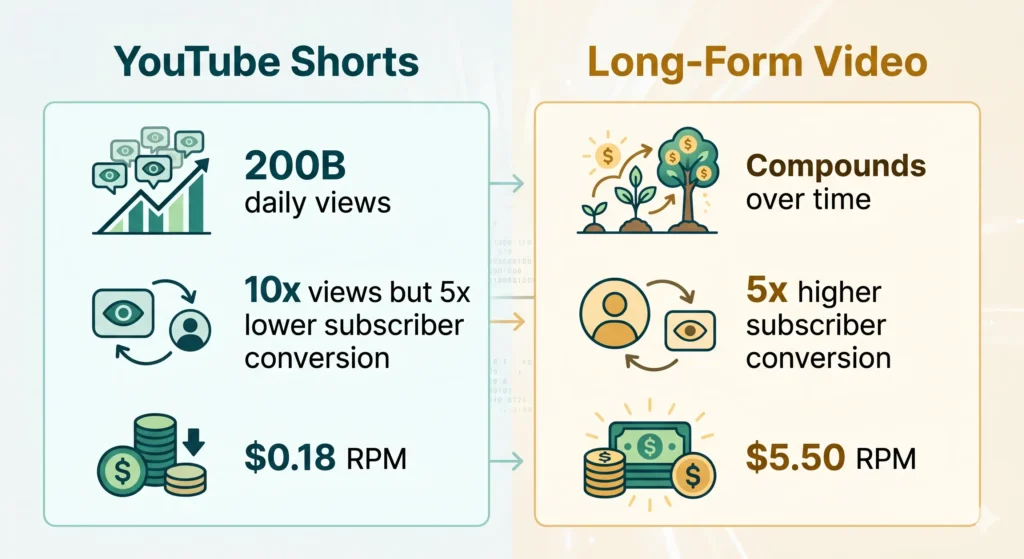
YouTube Shorts now generates over 200 billion views every single day — up from 70 billion in early 2024. That’s nearly a 3x increase in just over a year. The platform has 2 billion monthly users, putting it ahead of both TikTok and Instagram Reels in raw global reach.
The most important stat for new creators: 74% of Shorts views come from non-subscribers. When a Short hits 50,000 views, roughly 37,000 of those people had never heard of your channel before they swiped across your content. That level of cold-audience exposure is genuinely difficult to replicate through long-form alone — especially in your channel’s early months.
But — and this is critical — discovery doesn’t automatically translate into growth.
What Long-Form Does Differently
Long-form content builds something Shorts simply can’t: trust, depth, and staying power.
When someone clicks on a 10-minute video and watches 8 of those minutes, they’ve made a real investment. They’ve absorbed your tone, your thinking, your way of explaining things. That depth is exactly why long-form videos convert viewers into subscribers at roughly five times the rate of Shorts.
Long-form also compounds over time. A well-optimized video you post this week can appear in YouTube search results two or three years from now, still collecting views every single day. Shorts, by contrast, spike hard in the first 48 hours — then the algorithm moves on to the next piece of content.
For channels targeting search traffic and sustainable income, long-form is the foundation. Shorts is the megaphone that drives people to it.
The Growth Numbers Don’t Lie
Let’s get specific. Here’s what the data shows when you compare these two formats directly.
Shorts: Massive Views, Slow Subscriber Conversion
The raw view numbers for Shorts are almost impossible to argue with. But subscriber conversion tells a very different story.
Analysis of over 1,000 channels that grew from zero to 1,000+ subscribers in 2025–2026 shows that Shorts generate approximately 10 times more views than long-form videos — but with a subscriber conversion rate that’s around five times lower.
Why? Think about how people actually watch Shorts. They’re swiping fast. They’re in passive mode. Even if they genuinely enjoy your clip, hitting Subscribe requires a level of active commitment that doesn’t match the frictionless momentum of the Shorts feed. The algorithm rewards completion rate and re-watches — not long-term viewer intent.
This doesn’t make Shorts ineffective. It means you have to use them for what they’re actually good at: top-of-funnel discovery, not subscriber building.
Long-Form: Fewer Eyeballs, More Committed Fans
Long-form reaches fewer people — but the people it reaches are meaningfully different.
A viewer who watches 8 to 12 minutes of your content has already made a real choice. They heard your intro, stayed through your main points, and decided you’re worth their time. These viewers subscribe. They come back. They leave comments. They share. They’re the core of a real audience.
The average YouTube channel takes approximately 15.5 months to reach 1,000 subscribers. That timeline sounds slow — but long-form channels that hit that milestone tend to have a far more engaged, loyal base than channels that grew primarily through viral Shorts clips.
The Hybrid Advantage Nobody Talks About
Here’s the number that should change how you think about this entire debate.
Channels that publish both Shorts and long-form content grow 41% faster than channels using just one format.
Not 10% faster. Not 20%. Forty-one percent faster.
The reason is pure funnel mechanics. Shorts drive discovery — they put your content in front of new audiences at scale. Long-form converts that discovery into loyal subscribers who actually stay. Each format is doing the specific job the other one can’t. Together, they compound.
Monetization: Where the Real Money Lives
Growth speed matters. But if you’re building this channel as a business, the revenue math matters just as much.
Long-Form RPM vs. Shorts RPM — The Gap Is Shocking
Here’s a number that will likely reset your expectations.
Long-form videos on YouTube earn approximately $5.50 per 1,000 views in RPM. YouTube Shorts earn approximately $0.18 per 1,000 views.
That’s a 30x gap.
A Short with 100,000 views earns around $18. A long-form video with the same 100,000 views earns roughly $550.
The difference comes from ad structure. Long-form supports pre-roll ads, mid-roll placements, and multiple revenue touchpoints per viewing session. Shorts run a brief in-feed ad at much lower CPMs — because advertiser demand for short-form inventory is fundamentally different from demand for longer, intent-driven content.
For creators building toward AdSense revenue, long-form content is not optional. It is the revenue engine.
When Shorts Monetization Actually Makes Sense
That said, the Shorts revenue picture has improved meaningfully. YouTube’s Shorts monetization program now allows eligible creators to earn a share of ad revenue from Shorts, based on total views and music usage. For creators consistently producing content that goes viral — or hitting several million Shorts views monthly — the income is real and does add up over time.
But for most early-stage creators, treat Shorts income as a bonus, not a business model. The actual value of Shorts, at this stage, is the warm audience it delivers directly to your higher-RPM long-form library.
Which Format Should You Start With?
There’s no universal right answer — but the decision doesn’t have to feel random either. Here’s a practical framework.
Start With Shorts If…
You’re starting from zero and need channel visibility within the next 30–60 days. You can post 3 to 5 Shorts per week consistently. Your niche is visual or fast-paced: fitness, cooking, quick tutorials, reactions, rapid-fire tips. You want to test content ideas before investing hours in a full production. You’re still sharpening your on-camera presence and figuring out your niche focus.
Shorts lets you learn fast with real audience feedback. You’ll discover what resonates — and what completely misses — without betting three hours on a video that gets eleven views.
Start With Long-Form If…
Your niche is educational, review-based, or requires meaningful explanation. You want content that compounds and drives search traffic over time. Monetization within your first 12 months is a real priority. Your target audience skews over 30 and searches YouTube with specific intent. You’d rather build depth and authority than chase a viral moment.
Long-form also sets you up for better sponsorships further down the road. Brands pay significantly more for deep-engagement ad placements than for 30-second Shorts viewers mid-swipe.
The good news: you don’t need to commit to one format forever. Most successful creators build their core library in one format first, then layer in the second as their production workflow becomes more efficient.
The 2026 Strategy That Actually Works
Build a Shorts-to-Long-Form Funnel
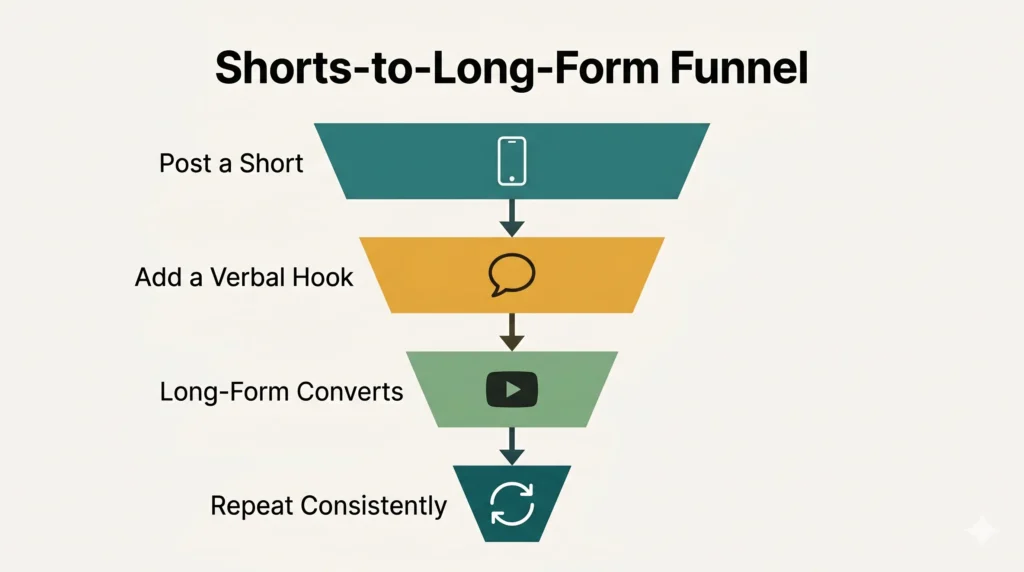
The creators growing fastest in 2026 aren’t arguing about Shorts vs long-form. They’re connecting the two formats into one system.
Here’s the funnel that works:
Step 1 — Post a Short that answers one specific question or shows one useful, actionable tip. Keep it under 60 seconds. Target a completion rate above 50%.
Step 2 — End with a verbal hook. Something like: “I just posted the full breakdown on this in my recent video.” No clickable link needed — the mention alone increases crossover views significantly.
Step 3 — The long-form video goes deep on the exact topic the Short teased. Viewers arriving from your Short are already warm — they’ve already decided you know your subject. Subscriber conversion from this group is significantly higher than cold traffic.
Step 4 — Stay consistent. Analysis of over 5 million YouTube channels found that creators posting 12 or more times per month gain 66% more subscribers and 53% more views than those posting just 1 to 3 times monthly.
Consistency beats perfection every single time.
The creators winning on YouTube right now are not the ones who made one brilliant video. They’re the ones running a repeatable system — and running it every week. Shorts bring people in. Long-form builds the relationship. Together, they grow a channel faster than either format ever could alone.
The answer to Shorts vs long-form was never either/or. It’s a sequence. Use both — in the right order.
What’s Next?
You now have a clear content strategy for growing on YouTube in 2026. The next smart move is thinking about what you actually offer your audience beyond ad revenue. One of the fastest ways to monetize as a creator is building and selling your own digital product — and it doesn’t require weeks of prep or a big team to launch.
👉 Read next: How to Create and Sell a Digital Product in a Weekend